Thursday, December 17, 2009

School Technology Survey

I am conducting a survey of school district policies. My hope with this survey is that if I get a comprehensive look at school and district technology policies and compare them to other demographic data that we might be able to spot trends and correlations. If you work for a school or school district please take a moment to fill out this extremely short survey.

Thank You


#ties2009 Twitter @TIES Conference


While this year's TIES Conference had one of the most impressive, valuable, and thought provoking lineups of any conference I have attended in recent memory, perhaps the most interesting thing was not on stage or formally part of any particular session. For me the most interesting aspect of this conference was what was happening on Twitter. Many of us used Twitter this year to take notes and share resources related to sessions. This allowed six powerful things to occur that were not as effortless in the past. I thought it would be worth some time today to identify these six things and reflect on their impact.

Five Things Twitter Made Possible at #ties2009:

1. Networking
2. Sharing Resources
3. Reflective Practice
4. Amplification
5. Outside Influence
6. Extra Innings


Networking:

Networking is a huge reason people in any field attend a conference. It is important from time to time to convene with colleagues from other places to share ideas, gain contacts, and establish relationships. It can even be argued that in the information age this is the only meaningful reason to justify the cost of attend a conference. Before Twitter I would go to a conference and only establish meaningful relationships with a hand full of people and the majority of those people just became another card in my Rolodex. Following the #ties2009 Twitter stream people were able to find other people to connect with with similar affinities. When meeting these new people in person many times we had already been engaged in a conversation so the time from hand shake to meaningful dialog was greatly reduced. Twitter also provides an integrated ability to contact other people, so if you make the connection there you already have an instant connection to that person. Goodbye Rolodex, hello Twitter follow stream.


Sharing Resources

One of the most concrete applications of this tool is as a platform for sharing resources. During keynote speeches and sessions participants often shared links to related content online. This is essentially a Google Jockey technique applied to a backchannel. These resources could either be set aside for reference after the session or brought up to add value to session goers experience.


Reflective Practice

Twitter facilitated many instances of reflective practice during and after sessions. It allowed attendees to re-contextualize ideas, pose questions to the group, and discuss topics.


Amplification

Each Twitter user has their followers, their followers have their own followers, and the web of relationships spreads out from there. Having our conversations on Twitter allowed the conference to be amplified beyond the Hyatt Regency in Minneapolis to a global audience. Tweeted notes from the sessions reached people both in regionally and globally who could not attend in person. It undoubtedly brought awareness of the conference to a broader audience. The thoughts and content of the sessions reached a much larger audience and will likely have a greater impact than if the message were only heard by those in attendance.


Outside Influence

Tweeting notes from sessions allowed people not attending the conference to follow what was going on and what was being said in real time. Essentially this allowed conference Tweeters to become proxies or conduits for those not in attendance. These proxies could ask questions posed by the network. These outside voices also could also make attendees aware of additional or contradictory views other than those presented in the sessions.


Extra Innings

Because the #ties2009 hash tag will outlast the conference indefinitely the conference has the potential to live on indefinitely in this space. For as long the TIES Conference Twitter users are engaged in conference discussion the conference can live on. This has enormous power especially for teachers otherwise relatively isolated either by geography or by school culture. The conference lasts only four days (if you include the weekend workshops) but the conversations regarding the conference could go on forever.
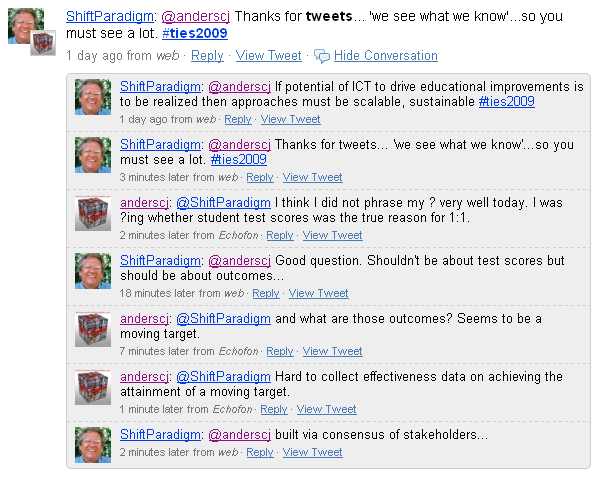

Additionally, each conference session is only so long and often session-goers are left with questions for the presenter or each other that time does not permit. For those of us connected, Twitter allowed for those questions to be answered and the conversation to continue well past the hour set aside for the presenter's session.

Wednesday, December 16, 2009

#ties2009 Dr. Robert Marzano - TIES Conference Day 2 Keynote

Promethean sponsored a great keynote address by Dr. Marzano on Tuesday. While this keynote address was not without some controversy his overall message and the majority of the details he presented were spot on. Even though Promethean's funding of his research and their sponsorship of his address at the conference infuses this research and message with a loaded bias the general message was sensible. What I came away with from his talk was that any teaching strategy done right will produce positive results and that technology can aide us in implementing these strategies and enhance positive outcomes. What matters is training and proper implementation.

Much of what Dr. Marzano said in this keynote validated what I already suspected and believed. However, nothing in his presentation indicated that a his findings would have been different had the teachers in his study only had a projector, nor did they compare results with 1:1 programs. The only mention he had of 1:1 was at the end when he said, "When asked whether we should spend money on Interactive Whiteboards or 1:1 laptops I say why not both?" This clearly indicates that he has no data yet that answers the question of what is better. The problem with this is for the price of an IWB a school could outfit at least five or six classrooms with projectors, set of netbooks, or iPod Touches. Presenting only the research on IWBs and not the others gives Promethean and SMART an advantage plus it may reinforce the teacher-centric model of instruction.

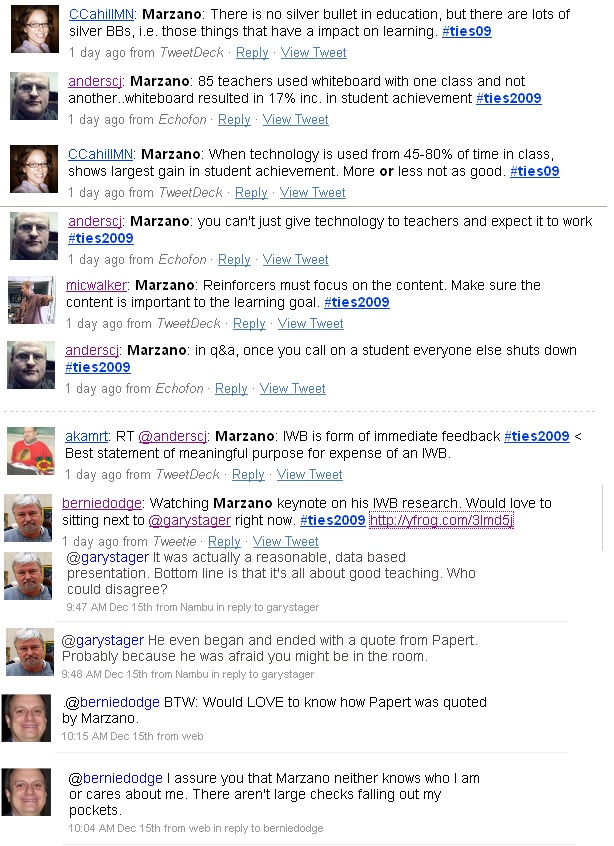
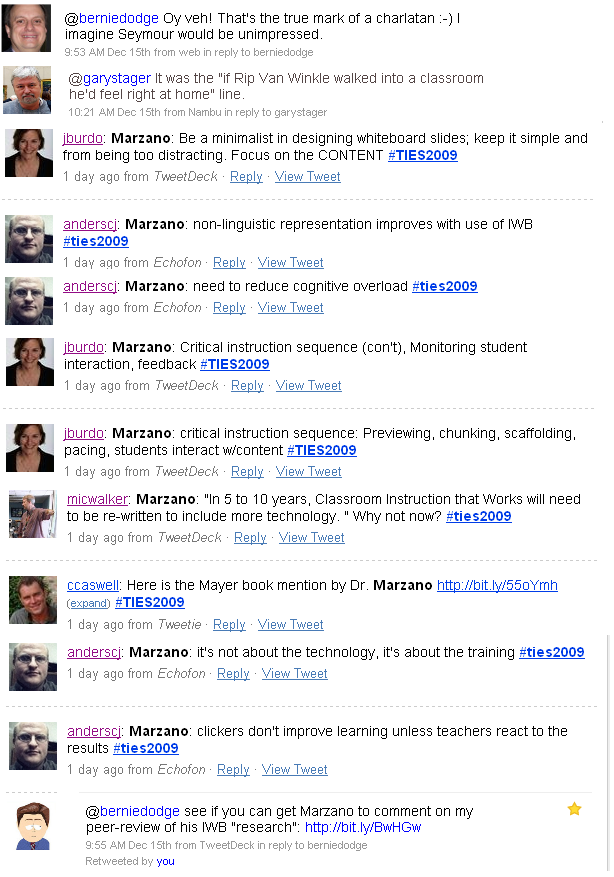
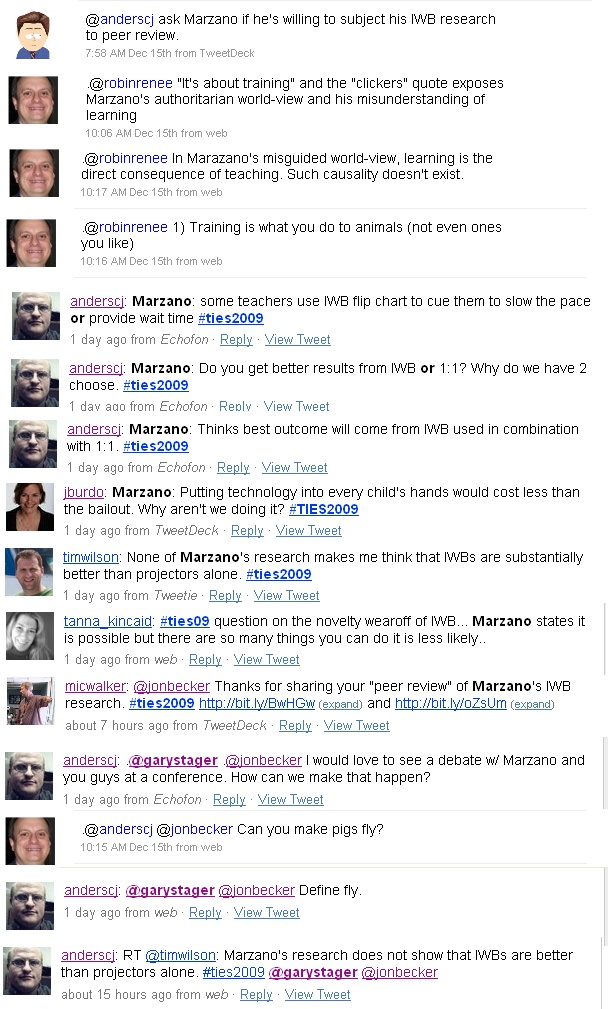
The most interesting thing that happened during this session was what was not happening in the session but on Twitter. Many of us at the conference were tweeting our notes. This gave people like @garystager and @jonbecker an opportunity for push-back even though they were not with us in Minneapolis. Their tweets certainly influenced the Q&A session that followed.

The following are some highlights from the twitter stream, it is full of tasty nuggets and juicy tidbits:


If you missed this keynote speech, here is the same speech given at CUE 2009:

#ties2009 Bernie Dodge on Engagement

One of the people I was most excited to meet and see speak at this year's TIES conference was Bernie Dodge. He presented two sessions at the conference, WebQuesting with GPS and Engagement: What Is It and Where Can I Get Some? Bernie Dodge was one of the advisers for the capstone I did for my MAed two years ago on Virtual World WebQuests but I had not met him in person yet, only via email and Skype.

I lament that I was only able to catch the end of his GPS session. However, most of the information from that session is on his website. Basically he posed a challenge to educators. Evidently there is an extreme shortage of WebQuests involving GPS technologies or geotools. He suggested eight different possible topics he would like to see developed:

  1. Small World
  2. Walking Tour
  3. DIY Lit Trips
  4. Critter Count
  5. Latitudology
  6. X from the Air
  7. Travel Chronicles
  8. Site Selection
He posed this as a contest and the winner wins a three year subscription to QuestGarden.

--------------------------


How do we attain this level of engagement with our students?


I was able to attend his session on Engagement in its entirety. The overall message of this session was an important one to hear at an education technology conference. Basically he reminds us to focus on the learning and not fall into the "Tijuana Syndrome" with technology where when we are in the tech environment things look good that might not look so good when we bring them home to our students. The following are some tweets from his session:


#ties2009 Mike Horn Keynote

Michael Horn, co-author of Disrupting Class and founder of the think tank @InnosightInstit kicked things off at the TIES conference on Monday with a great speech about disruptive innovation and it's impact on education. I was excited to hear him speak. I have been following his work for quite some time. It was exactly the right message to be delivered at this conference at this time and set the stage for great conversations the whole conference.

Rather than blog my notes, this year I tweeted them. The following are some key points from his keynote via Twitter:


----------------------------------------------------------------------------

Interview with Michael Horn on EdTechTalk: