Monday, August 8, 2011

Twitter Book Club: Theodore R. Sizer (1984) Horace's Compromise - Part I: The Students


Part I: The Students

1. Five Adolescents

"We adults too easily talk of these adolescents as an undifferentiated blob of people, as a Client Group or an Age ... http://tl.gd/blks9bless than a minute ago via Twittelator Favorite Retweet Reply


"We should expect them to learn more while being taught less. Their personal engagement with their own learning is ... http://tl.gd/blku4iless than a minute ago via Twittelator Favorite Retweet Reply


Lets repeat that shall we:
"We should expect them to learn more while being taught less. Their personal engagement with their own learning is crucial: adults cannot 'give' them an education. Too much giving breeds docility, and the docility of students' minds is a widespread reality in American high schools." Sizer
This pretty much sums up the problem with our traditional banking method of education. The teacher's job is not so much to cover content but to create the environment for students to explore and discover content, and environment where they can learn. Sizer acutely points to the counter-intuitive impact too much "teaching" does. This also lies at the heart of the high-stakes testing dilemma. The greater the pressure to teach to the test the greater likelihood content will be covered through telling rather than authentic learning. Telling takes the work away from the student who needs the work in order to learn, a truth easier to see when the high-stakes testing foot is not grinding down on your neck.


2. Diversity

"Listen to how staff responds to parents on the school's telephones: those of wealthier children are likely to be p... http://tl.gd/bll2culess than a minute ago via Twittelator Favorite Retweet Reply


"Children who grow up believing from their experience that their families—their worlds—will protect them have an ea... http://tl.gd/bll3meless than a minute ago via Twittelator Favorite Retweet Reply


"The hard fact is that if you are the child of low-income parents, the chances are good that you will receive limit... http://tl.gd/bll6ttless than a minute ago via Twittelator Favorite Retweet Reply


"One leaves visits to dozens of American high schools with the clear feeling, however, that race is a fixation of a... http://tl.gd/bll9usless than a minute ago via Twittelator Favorite Retweet Reply


3. Commonality

"To the larger world, one is what one appears, whether six, sixteen, or sixty. When teachers say, 'Act your age,' t... http://tl.gd/bm8fhsless than a minute ago via Twittelator Favorite Retweet Reply


"Can an ungenerous and irresponsible adult culture long get away with preaching virtue to its young?" Sizerless than a minute ago via Twittelator Favorite Retweet Reply


Nope. But, it seems in the current climate many adults don't even wish virtue to be preached to their young. The impression I get sends the opposite message:


Sorry about that. Couldn't help myself. Do you think these children made these signs? I see this sort of thing everywhere.

"The attitudes of parents and their expectations for their children are very powerful influences indeed, far more p... http://tl.gd/bm8pqsless than a minute ago via Twittelator Favorite Retweet Reply


"We should show them respect by expecting much of them and by being straight—and part of being straight is telling ... http://tl.gd/bm8rroless than a minute ago via Twittelator Favorite Retweet Reply


"One cannot shield an adolescent from all risk and hurt; to do so would be to deny that young person the essential ... http://tl.gd/bm8stfless than a minute ago via Twittelator Favorite Retweet Reply


"There is no more difficult teaching job than that of helping an adolescent into adulthood. Few jobs are more thank... http://tl.gd/bm8tmjless than a minute ago via Twittelator Favorite Retweet Reply


5. Incentives

"If a school awarded the diploma whenever a student reached the agreed-on level of mastery at the completion of a s... http://tl.gd/bmrsksless than a minute ago via Twittelator Favorite Retweet Reply


It seem like more schools are going this route now with standards-based assessments.

"Credit-counting may be financially cheap; educationally, it is very costly." Sizerless than a minute ago via Twittelator Favorite Retweet Reply


"Get a person to believe in himself and give him a powerful incentive to learn, and the results can be striking." Sizerless than a minute ago via Twittelator Favorite Retweet Reply


"A school which assumes that students will respond to challenge, rather than shrink from it, will be effective." Sizerless than a minute ago via Twittelator Favorite Retweet Reply


I couldn't agree more with these last two quotes. I hate when I am working with a group of teachers and hear things like, "My kids could never do that," or "You should see the kids I work with, they could never..." Always a self-fulfilling prophecy.

"None of us learns what we think we can't learn." Sizerless than a minute ago via Twittelator Favorite Retweet Reply

And, if teachers believe their students can't, then they will send that message to the kids. Chances are most of them will believe it.

"Almost no school that I've seen gives mastery more prominence than it gives its routines." Sizerless than a minute ago via Twittelator Favorite Retweet Reply


"Very few high schools ever give their students a clear long-term academic goal and an equally clear signal that it... http://tl.gd/bms585less than a minute ago via Twittelator Favorite Retweet Reply


"We teachers are too nice: we test the kids, and take the blame if they fail." Sizerless than a minute ago via Twittelator Favorite Retweet Reply


Sunday, August 7, 2011

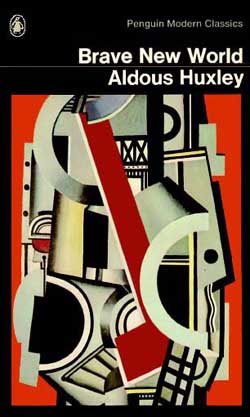
Twitter Book Club: Aldous Huxley (1932) Brave New World


I don't normally read novels for Twitter Book Club, I usually read education related books. In fact, the only other non-education text I've read for TBC so far was E. M. Forster's (1909) The Machine Stops.

Both Brave New World and The Machine Stops are distopian visions of our future and somewhat similar. Where Forster feared future man would place their faith in a grand machine, Huxley feared we would place our faith in industrialized production and consumption. Both stories have great relevance for education and both seem to be looking on our time (or our near future time) saying "I told you so." I highly encourage you to read Brave New World through the lens of what we are doing to public education today with common core curriculum, mood and behavior altering drugs, mindless entertainment, glorification of ignorance (both in entertainment and in politics), tracking students by age and ability, the roles of science & religion in education, etc.

This book didn't lend itself very well to my normal TBC method. There really were not very many quotable quotes. Most of the best stuff in this novel is situational and not very well represented in 140 characters (even with Twitlonger). Therefore, I've abandoned my normal routine of archiving by chapter. What follows are the few tweetable passages that really grabbed my attention:


"For particulars, as everyone knows, make for virtue and happiness; generalities are intellectually necessary evils." Huxleyless than a minute ago via Twittelator Favorite Retweet Reply


"Major instruments of social stability...Standard men and women; in uniform batches." Huxleyless than a minute ago via Twittelator Favorite Retweet Reply


Isn't this what lies at the heart of the Common Core movement? Social stability by creating standard men and women? Of course, to have this view you must also see students as "adults in training" and the purpose of education as preparation for the future, not preparation for the now.

"All conditioning aims at that: making people like their inescapable social destiny." Huxleyless than a minute ago via Twittelator Favorite Retweet Reply

This is exactly the problem I have with programs like Project Lead The Way. While I am a huge supporter of project-based learning, PLTW is kind of like the fast food version of PBL, what Gary Stager refers to as Ed Reform TM. While on one hand, PLTW is helping to introduce more constructivist pedagogies in places where they are not as likely to be tried, it does so in a very watered-down fashion. It also does so for reasons that completely echo this quote from Huxley. If you aren't familiar with PLTW, it is a scripted STEM curriculum written and funded by corporations for the explicitly stated purpose of getting young people excited about careers that these corporations project will be in high need in the near future. While student needs and corporate needs can sometimes be in conjunction they can also sometimes be in opposition. Either way, this kind of curriculum can only be described as conditioning. You have to ask yourself, is this OK?
"Alpha children wear grey. They work much harder than we do, because they're frightfully clever. I'm really awfully glad I'm a Beta, because I don't work so hard. And then we are so much better than the Gammas and Deltas. Gammas are stupid. They all wear green, and Delta children wear khaki. Oh no, I don't want to play with Delta children. And Epsilons are still worse." Huxley
This passage from Brave New World reminds me of this article I read this week http://www.guardian.co.uk/education/2011/jul/25/secondary-school-streaming

"when you're not accustomed to history, most facts about the past do sound incredible." Huxleyless than a minute ago via Twittelator Favorite Retweet Reply


It is amazing how soon we seem to forget our past, even our recent past. That is why we need people like Ira Socol and Diane Ravitch. We need to be constantly reminded of our past and view present and future endeavors through a historical lens. I know it's a cliche but that doesn't make it any less true that, "Those who do not know history are doomed to repeat it."

"Words can be like X-rays, if you use them properly—they'll go through anything." Huxleyless than a minute ago via Twittelator Favorite Retweet Reply


"what would it be like if I could, if I were free—not enslaved by my conditioning." Huxleyless than a minute ago via Twittelator Favorite Retweet Reply


"The greater a man's talents, the greater his power to lead astray. It is better that one should suffer than that m... http://tl.gd/c5h4jhless than a minute ago via Twittelator Favorite Retweet Reply


"You've got to choose between happiness and what people call high art. We've sacrificed high art. We have the feeli... http://tl.gd/c70ae4less than a minute ago via Twittelator Favorite Retweet Reply

It seems like this is a decision we are in the process of making for ourselves today. How much have the fine arts declined in our schools? How much have the fine arts moved to be something for the elite?

"Actual happiness always looks pretty squalid in comparison with the overcompensations for misery." Huxleyless than a minute ago via Twittelator Favorite Retweet Reply

This idea really struck a cord with me. I've been thinking about it all day. I'm not sure actual happiness was what Huxley meant here, I think contentment seems like a better fit.

"we have our stability to think of. We don't want to change. Every change is a menace to stability. That's another ... http://tl.gd/c70jsvless than a minute ago via Twittelator Favorite Retweet Reply


"One believes things because one has been conditioned to believe them. Finding bad reasons for what one believes fo... http://tl.gd/c7mdqcless than a minute ago via Twittelator Favorite Retweet Reply


"Getting rid of everything unpleasant instead of learning to put up with it. Whether 'tis better in mind to suffer ... http://tl.gd/c7mn5aless than a minute ago via Twittelator Favorite Retweet Reply


This reminds me of this TED Talk about "filter bubbles:"

Wednesday, August 3, 2011

Our Brave New World

Inspired by the countless references by Neil Postman and others I have decided to read Huxley's (1932) Brave New World. I've actually become quite obsessed with it these past few days and have gone so far as to watch both movie versions of the book. The older one, which I believe was originally a 1980 mini series, is probably closer to the book although neither stays completely true to Huxley's text. One scene from the film struck me as quite powerful, more so than it did in the text:


"Recent implies past. Improvement implies progress. And if the present is perfect then there cannot be any progress."

"Of Course."

"And even the word why--why, that's the most dangerous of all. It raises the whole question of purpose."


Does this sound familiar? Prescribed training sessions? Scripted lessons? Society which holds consumption up as the ultimate virtue? This is indeed where we are headed in this country if we let our current education policies run their course. In the book, the future "Other Place" is a place which has eradicated art, history, family, and emotion and replaced it with standardized people who serve one purpose, to drive the economy through consumption; and in so doing endlessly indulge themselves in an orgy of shallow pleasures. Isn't this the kind of values and ethic portrayed to us on television, in the movies, and on billboard advertisements. Have you watched much television lately? To what purpose is this reality TV but to condition people into thinking there is a different norm to which they ought to aspire to?

It is good to buy things:


It is bad to keep them:


So, it is better to just clean house and throw it away:


And it is cool to be promiscuous, uneducated, and just endlessly party:


I mean, don't those kids look happy? And to boot, they are all famous. They didn't get an education, what a waste of time. No, they are revered because they are good consumers and completely self-indulgent.

Besides, education will only bring you misery. Just look at how teachers are treated. Teachers have education and they don't get paid very much and are continuously being degraded. And besides, the news tells us that most teachers are ineffective and grossly overpaid for their work. No one likes that. Nope, you are better off trying to become famous like Snookie or the Situation and spend all your time having fun.

As for being original and creative, that's overrated and unnecessary because now we have talent shows and karaoke. Places where original work is not valued (skip to 0 min 47 sec):


or to put it more elaborately:


I think Huxley had us pegged.

In the book, the character Bernard Marx makes this statement, "what would it be like if I could, if I were free—not enslaved by my conditioning."

We should ask that of ourselves as well. First, we must become aware of our own conditioning (not an easy feat). Then, we must have the capacity to imagine life differently. But then, if we reject our conditioning we risk banishment, don't we?

Any ideas on how to do this?