Showing posts with label Seymour Papert. Show all posts

Monday, February 27, 2012

Twitter Book Club: Seymour Papert (1993) Mindstorms: Children, Computers, and Powerful Ideas


Wednesday, February 23, 2011

Motivation, Discrimination, and Social Learning #TechEquity Breakout-Session

Today I will be facilitating a break-out discussion session at our Technology & Equity in Education Symposium at Hamline University. Our discussion will focus on this video:


Compare differences and similarities we face today with education and technology.
  • Have things changed?
  • What do the issues raised by these three men mean for educators?
  • What do they mean for schools?
Any response to these questions in the comments below will be shared with the group and greatly appreciated.

Thursday, January 27, 2011

The health benefits of low hanging fruit.


I have a confession to make. When it comes to cell phones and driving I am not always the best role model. I have an eighty minute commute to and from work and most of that time is spent on a rural highway. When driving conditions are good I often, even though when I bought my current phone I said I wouldn't...tweet. I know, I know, it is bad for me, it's not safe, I need to pay attention to the road, etc. etc.

One of the other dangers of tweeting from my phone is the limitation it puts on my ability to communicate. I run the risk of posting something or getting into a conversation that really requires a longer format to make myself understood by others. I ran into this problem today with this tweet:

@garystager @djakes I'm thinking sometimes eating the low-hanging fruit is good for you.less than a minute ago via Mobile Web


to which Jakes replied:

@anderscj Not sure what you mean.less than a minute ago via web


I believe I owe David an Gary an explanation.

"Low hanging fruit" is a reference to a part of Gary Stager's talk from Tuesday with Steve Hargadon on his Future of Education series. In that talk Stager describes the "edtech" stuff regarding Web 2.0 as "low hanging fruit" and calls for educators to go beyond that and discover how technology can truly have a transformational impact on learning and schools (Gary, I am with you on this). He then announced his new project, The Daily Papert, which attempts to draw attention to some of the fruit higher up on the tree.

In the car on my way home I began to reflect on Gary's talk and started to think back to two blog posts I read this week: David Jakes' post Change Change and Deven Black's post The Worst Words in Education, and to the State of the Union Address Obama gave on Tuesday.

In his post, Black does a wonderful job of describing the problem we have with our nation's current mindset regarding education and how it is harmful for children. That same mindset we all heard Tuesday night immediately following Stager's talk when the president spent a considerable portion of his state of the union speech on education. The wrong-headed conception of education as something that is competitive and that, as Gary pointed out, it is "a scarce resource" was clearly on display. This view of education and schooling is clear from the namesake of programs like Race to the Top and from the following statements given Tuesday:

If we want to win the future—if we want innovation to produce jobs in America—then we also have to win the race to educate our kids. #SOTUless than a minute ago via HootSuite


and

"We need to teach our kids that it's not just the winner of the Super Bowl who deserves to be celebrated but the winner of the science fair"less than a minute ago via TweetDeck


And as Heidi from New Jersey pointed out from the speech,

this is all particularly important and relevant bc reformers cite models of military as models for education. Teachers are "Nation builders"less than a minute ago via web


All of which beautifully describes the situation we are up against that David Jakes responds/reacts to in his post. That which creates conditions and mandates that "are real and you have to respond." In that post Jakes also explains:

If you face these initiatives, you don’t really worry about Facebook, you don’t worry about social media, you don’t worry about the “conversation,” and you certainly could care less about a disjointed, abstract set of tweets on a Tuesday night in Twitter, all centered around a hashtag.

You don’t even have time for listening to presentations from a “reform” conference. That’s on a Saturday, and I think I’ll spend it with my family, thank you very much. I already know about social bookmarking.

Both Jakes and Stager are addressing the same issue albeit in rather different ways. And both are classifying things like the Reform Symposium and the #edchat conversations that happen as "low hanging fruit." I too have felt this frustration as I believe anyone who has had a deeper experience with how technology can change the nature of learning both for themselves and for their students. I even wrote about it last summer: #edchat You Ain't Got No Pancake Mix!

Today Gary announced his new project, The Daily Papert, and solicited people to send him their favorite Seymour Papert quotes. While not necessarily my favorite, one that has stuck with me because I believe it addresses this issue perfectly comes from chapter 3 of The Children's Machine:

"From an administrator's point of view, it made more sense to put the computers together in one room--misleadingly named "computer lab"--under the control of a specialized computer teacher. Now all the children could come together and study computers for an hour a week. By an inexorable logic the next step was to introduce a curriculum for the computer. Thus, little by little, the subversive features of the computer were eroded away."
That erosion has so fully damaged our school system that today even the "low hanging fruit" has a subversive effect. At the end of the day, after being exhausted and beaten down by the mandates and initiatives forced upon teachers that Jakes and Black describe, the low hanging fruit is often all there is energy left to reach. I know we should strive for more and we absolutely should set higher expectations than just learning about the latest web 2.0 tool but low hanging fruit is still fruit and fruit is still good for you. And, eating the low-hanging fruit will likely make people hungry for what is a little harder to reach.

So, while driving and away from access to a more dynamic way of expressing my thoughts, this is what was going through my head when I posted that tweet about low-hanging fruit.

Sunday, December 12, 2010

Twitter Book Club: @DianeRavitch (2010) The Death and Life of the Great American School System - Ch 7

Choice: The Story of an Idea

"the concept of school choice found a home among free-market-oriented foundations and think tanks, such as (cont) http://tl.gd/7b5u95less than a minute ago via Twittelator


I am still a big supporter of school choice initiatives. Perhaps it is because the data used to show they are no better than traditional schools are not the data I see as being a good indicator of how to answer this question. I don't like what has become of the school choice movement but I still hold onto the original vision by people like Albert Shanker and believe we can come back to it. The damn honest truth is there are students for whom traditional schools are not well suited. I have seen many good charter schools and other schools of choice who provide the kind of learning environment these kids need, learning environments that those who uphold the status quo would never let exist within the walls of their schools. I think Seymour Papert summed it up best in this clip from 1995:


"Cyber-charters, which offered online instruction to students at home, were receiving full payment for each (cont) http://tl.gd/7bqnapless than a minute ago via Twittelator


@DianeRavitch Curious, have you read Disrupting Class? What is your take on Christiansen & Horn's assessment?less than a minute ago via Twittelator


"When a school is successful, it is hard to know which factor was most important or if it was a combination of factors." Diane Ravitchless than a minute ago via Twittelator


"Certainly schools can improve and learn from one another, but school improvements—if they are (cont) http://tl.gd/7bqu6eless than a minute ago via Twittelator


---------------------------------------------------------------------------
Side Conversation with the author:

Axiom for the day: No school ever improved by closing it.less than a minute ago via web


@DianeRavitch I am not sure that statement is true. I can think of plenty of terrible schools where no school would be an improvement.less than a minute ago via Twitterrific


@anderscj Firing entire staff with no evaluation is wrong. Who put them there? District leadership is responsible.less than a minute ago via web


@anderscj Are the schools terrible because lowest performing kids were dumped there? Or are the teachers cruel and stupid? Who hired them?less than a minute ago via web


@DianeRavitch what about the voucher school you cite in Death & Life run by a para & a custodian? Better fixed or closed?less than a minute ago via Twitterrific


@anderscj That is not a public school and is a good example of why vouchers don't work.less than a minute ago via web


@DianeRavitch Yes, but you said, " No school ever improved by closing it," not "No public school..."less than a minute ago via Twitterrific


---------------------------------------------------------------------------

@dianeravitch can't this also be said about the needs of students in traditional schools? Is meeting the (cont) http://tl.gd/7cf859less than a minute ago via Twittelator


Let me repost that:
can't this also be said about the needs of students in traditional schools? Is meeting the learning needs of some worth ignoring the needs of others?

"The EPI authors said that the question to be answered was not whether charter schools, on average, outperform regular public schools, 'but rather whether the underperformance of some charter schools is a price worth paying for the overperformance of others.'"


@DianeRavitch How can we know that a student who performed well in a charter school would or wouldn't perform (cont) http://tl.gd/7cfcutless than a minute ago via Twittelator


Another unanswered question that I believe is worth everyone considering with regard to Charters.

"Charter schools enroll the most motivated students in poor communities, those whose parents push them to (cont) http://tl.gd/7cfirtless than a minute ago via Twittelator

Friday, September 3, 2010

The Death of Subjective Values

Cross-post from Dangerously Irrelevant

Image by opensourceway


This summer I have been conducting an experiment. Rather, I have been engaged in a personal project. I call it Twitter Book Club. Twitter Book Club is rather simple, it has one member--me. The goal of Twitter Book Club was three-fold: 1. To see if social construction can be simulated in a solitary activity; 2. to place into the Twitter stream voices of others who would not otherwise post their words in that space on their own; and 3. To provide personal motivation to read, or re-read through slow digestion of text, books that I had not read but feel I should have, books that I read a long time ago and feel a need to revisit, and books I read or were exposed to in graduate school but had not taken time for slow digestion. The day following each chapter I archive the tweeted quotes and their resulting conversations on my blog and add my own personal reflections and commentary.

The result of this project has been profound for me. Nearly every night when I sit down to read I end up engaged in conversations with others on the topics brought up in the book(s). These conversations sometimes continue on throughout the next day. I also have noticed a lot of related talk on other people's blogs and in the nature of the conversations among educators I have been following. I don't know if this is due to Twitter Book Club or if Twitter Book Club has placed me on alert to these topics and themes and thus I am more apt to find them. Either way it has benefited my own personal learning. I have also found that through the conversations I have had with others around these books I have brought upon myself an obligation to continue night after night. This obligation becomes a powerful motivation to keep reading and keep the Tweets coming.

Additionally, the books I have read for Twitter Book Club have given me the words to express many things that I have long felt but lacked the language to articulate. This is especially true for issues related to the nature of learning, standards, accountability, equity, and oppression. The books which, I feel, have contributed the most to my clarification of thought on this matter are John Dewey's Experience & Education, Ivan Illich's Deschooling Society, Seymour Papert's The Children's Machine, and Paulo Freire's Pedagogy of the Oppressed.


I Am An Art Teacher in Exile.


Before I explain the thinking that these four authors helped me to clarify I believe it is important to briefly relate to you my own story. I began my teaching career in the year 2000 as an art teacher. Time and time again, despite repeatedly receiving high marks and awards for my performance I found myself in the position of looking for a new job. With one exception where I chose to leave to move closer to family every art position I ever held was eliminated. In the course of seven years I held five different art teacher positions in five different school districts. When I left these jobs I was the last to fill them and no one would be hired to take my place. I would take this personally were it not for other art teachers in these and neighboring districts also loosing their jobs or forced to work for reduced FTEs. Naturally, I began to wonder why this is happening when it seems the arts embody so many of our culturally shared values. No one will openly tell you that the arts are not important yet what is happening in our schools in this past decade seem to contradict this value.

Especially difficult for me was the loss of an art teaching position at an alternative school serving "at-risk" students who did not find success in the traditional school system. When a student at a school is not finding that environment suits their educational needs schools will do what they can to place them in another setting. Often this ends up being alternative schools. Our school was special. It was small, only nine teachers and three educational assistants. We had a part-time principal but her time had to be split in such a way between her other jobs that she was not able to handle many of the daily operations of our school. She entrusted the day to day operations and decision making to the teachers. We grew to be a tightly-knit family of nontraditional educators. We hared a common workspace by choice and regarded instructional spaces in the school to be shared resources. We were responsive to the unique needs of the students we had and over the course of a year developed a program that tended to collect and keep the kinds of kids who typically get passed around the system. We found our work worthwhile and felt like were were making a real difference for the students we served.

Our program grew fast and by the end of the year our superintendent told us he needed to bring on a full-time administrator to help us run the school. Within a year most of the authentic organizational structures our team had built were disassembled. Our shared spaces were subdivided and assigned to us as "our own" spaces, our common workspace was broken up and we were officed in our own classrooms. Bringing on this administrator meant that we had a projected budget deficit. We were told that we would have to further increase our enrollment or we would be forced to make cuts. Of course, those cuts would not involve the newly hired full-time principal, they would be program cuts. Additionally, we were all asked to make the case for how our programs added value and should be kept. Of course, this pitted us against each other and led our family into a state of dysfunction. The end result was that kids left. Some dropped out and others transferred schools. In fact, our enrollment dropped so drastically that nearly half the staff was forced to be let go in the end, including myself.

So, having been burned so many times trying to support my family as an art teacher I decided to make a career change. Now, as an art teacher in exile, I serve schools a technology integration specialist. In that role I have witnessed both the loss of fine arts FTEs in schools continue and the continued passing around of the children left behind by our current education system. Why is that? The answer to that question is what Freire, Illich, Dewey, and Papert clarified for me.


Objective Versus Subjective Assessment


"The appeal [of back to basics education] may be temporarily successful in a period when general insecurity, emotional and intellectual as well as economic, is rife. For under these conditions the desire to lean on fixed authority is active. Nevertheless, it is so out of touch with all the conditions of modern life that I believe it is folly to seek salvation in this direction." John Dewey (1938)

Dewey wrote this statement in 1938 (or at least it was published in that year). In that time the world was well into the Great Depression and as far as general insecurity goes, the general public likely looked a lot like the general public today. Dewey characterizes traditional education, of which standards, subject matter, and textbook curriculum are all paraphernalia, as an education of the past. In changing times, in times of instability and insecurity, it is natural for many people to want to hold on to the past and a good way to do that is with scripted standardized curriculum.

The problem is, standards require a world view that is fixed and objective, a world view that can be measured and assessed objectively. It is hard, if not impossible, to create standards based on subjective reality. For this reason, state standards in content areas with stronger subjectively added value and areas that are best assessed via subjective means are pushed aside for they pose a problem. How do you objectively assess the value of a painting, song, dance, poem, or play without killing that which we find value in it? Paulo Freire (1970) tells us that this kind of denial of subjectivity is naive and simplistic. He takes it one step further by saying,
"The separation of objectivity from subjectivity, the denial of the latter when analyzing reality or acting upon it, is objectivism." Paulo Freire (1970)
This is exactly what is happening in education today. By denying the value in subjectivity and placing all value on what are perceived as objectively defined standards and assessments we have objectified the subjects we teach.


The Objectification of Subjects

"The notion that some subjects and methods and that acquaintance with certain facts and truths possess educational value in and of themselves is the reason why traditional education reduced the material of education so largely to a diet of predigested materials." Dewey
We are living in a time of heightened accountability. The world is changing and people want to know who to hold accountable when things fail. This is easier done objectively than subjectively so when we need to know if our kids are learning what they should be learning in school we give them standardized tests to objectively measure their progress. Of course this is easier to do for subjects like math, science, and reading than it is for the fine arts, social studies, or anything else that requires subjective reasoning. A Scantron machine cannot tell you if your painting is good or how beautifully you played a melody. When students fail to meet adequate yearly progress on these objectively measured assessments schools prescriptively move resources to those areas that are being measured. An addition in one place requires a subtraction in another. Therefore, the subjects that offer subjective value are cut.

In an attempt to justify their existence and fit them within the framework of standardized curriculum all school subjects are necessarily objectified. This objectification kills the subject, a point Seymour Papert (1993) addresses, "The learning of a dead subject requires a technical act of carving the knowledge into teachable bites so that they can be fed to the students one at a time by a teacher, and this leads straight into the traditional paraphernalia of curriculum, hierarchy, and control." The standards movement also narrows the curriculum immensely and in its comprehensive inclusion of benchmarks that need to be taught eliminates an infinite number of types of learning to occur or subjects to be examined.
"The extreme conservative side is to follow what is already in the school curriculum: There is already more there than children seem to be able to learn; reformers will do better to improve teaching what is there than aggravating the situation by quixotically proposing new subjects. But on my reckoning, the fraction of human knowledge that is in the curriculum is well under a millionth and diminishing fast. I simply cannot escape the question: Why that millionth in particular?" Seymour Papert (1993)

Ivan Illich (1970) takes this argument a step further and declares that since the portion of the world for which school learning examines is so narrowly defined it, "becomes unworldly and the world becomes uneducational." And, takes a stance which echoes Dewey's stance on the nature of the relationship between learner and their environment by saying,

"The planning of new educational systems...must not start with the question, 'What should someone learn,' but the question, 'What kind of things and people might learners want to be in contact with in order to learn?'" Illich

The objectification of subjects into standards to be assessed objectively leads to a reinforcement of what Dewey calls "Traditional Education" and methods which Freire calls the "banking method." This banking method of traditional education requires a teacher to be prescriptive in their methods which Freire categorizes as one of the basic elements of an oppressive relationship and one which pacifies the students and hinders their creative and critical capacity.

"The capability of banking education to minimize or annul the students' creative power and to stimulate their credulity serves the interests of the oppressors, who care neither to have the world revealed nor to see it transformed." Paulo Freire (1970)


The Objectification of People

"Plato once defined a slave as the person who executes the purposes of another, and, as has just been said, a person is also a slave who is enslaved to his own blind desires." John Dewey (1938)
By eliminating subjectivity from our assessment of student and teacher performance on standardized assessments we thus objectify the people we measure. I believe this is what lies at the heart of the teacher accountability debate. It is where John Merrow and Grant Wiggins get it wrong on this post and why the LA Times article listing "ineffective" teachers based solely on objective measures is wrong. According to Freire this kind of action constitutes an objectification of teachers and their students. He also says that objectification is an act of oppression and violence.

"being less human leads the oppressed to struggle against those who made them so...for this struggle to have meaning, the oppressed must not...become in turn oppressors of the oppressors" Paulo Freire (1970)

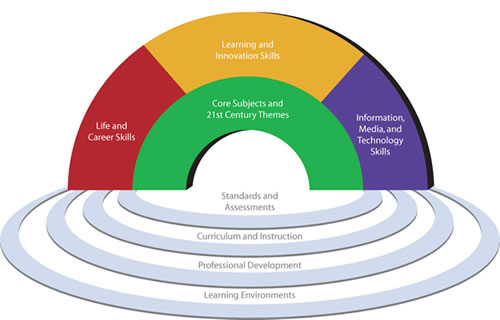
As I read Paulo Freire I can't help but put his words in the context of the current debate regarding standards, P21, and teacher accountability. It seems as though P21 folks and curriculum standards folks are pitted against each other in this debate in a polarizing way. If the standards movement and high stakes testing represent the pedagogical strong arm of the dominant class then the P21 movement is a counter movement that threatens the cultural heritage embedded in the standards-based structure. However, P21 looks as though it has set itself up to be equally oppressive, it has all the trappings of the standards movement including a "core curriculum," strictly segmented subject areas, predefined skills, etc.

"[The oppressed] are at one and the same time themselves and the oppressor whose consciousness they have internalized." Freire

This is a profound thought for me and a key point for this book. That the oppressed are simultaneously oppressed and their own oppressors is a fascinating concept and, I think, a difficult realization for many. I am reminded of this scene from what was one of my favorite movies growing up, Labyrinth:


The truth is we have internalized this struggle between subjective values and objective assessment. It is why many arts advocates fail in their efforts to save programs from being dissolved and their funding reallocated. In this case we are our own worst enemies. Our own fear of liberation prevents us from renouncing this internal oppressor. So, under this oppressive system we are forced to live with a decrease in the capacity for inquiry and the elimination of subjectively measured subjects, subjects which best help students develop critical thinking skills and creative capacity.


Critical Thinking


Subjective assessment involves critique. It is in the areas of study that require personal and group critique in their assessment where the ability to think critically is developed. To critique a painting, a piece of music, a dance, or poem requires one to observe, analyze, interpret, and evaluate in ways the require higher order thinking. A math equation requires these steps too but only in an objective capacity. The type of knowledge our standardized tests measure in this capacity is rather shallow. It is only in the study of subjectively measured learning that this capacity can be deepened.

This critical capacity is not self-serving though, it carries through to the solving of problems in all areas of life. I am a better technology integration specialist because I have spent a lot of time in the creative arts. Because of my creative capacity I am able to see solutions to problems other "technologists" cannot. The reduction of the sorts of programs in schools that allowed me to develop this capacity means that fewer people will be given the same opportunity to develop this capacity in themselves. Thus, we will end up with a deficit in critical capacity. I will let Paulo Freire finish this line of thought for me in these four quotes
  • "they react instinctively against any experiment in education which stimulates the critical faculties"
  • "dialogue cannot exist unless the dialoguers engage in critical thinking"
  • "Without dialogue there is no communication, & without communication there can be no true education."
  • "In their political activity, the dominant elites utilize the banking concept to encourage passivity in the oppressed, corresponding with the latter's 'submerged' state of consciousness, & take advantage of that passivity to 'fill' that consciousness with slogans which create even more fear of freedom."

Alienation & Lost Histories

"Schools by their very structure resist the concentration of privilege on those otherwise disadvantaged." Ivan Illich (1970)
Through extended loss and reduction of the fine arts from our schools we are alienating not only those subjects but the people who most closely value them. If we continue to allow the arts to be repressed in the name of standards and accountability over time their history and tradition will be lost.

I know for a fact that many of the students at the alternative school I worked at stayed with us and stayed in school because of my art program. I know many of these students were deemed undesirable by the system. Yet, though they may not perform well on a standardized test they were particularly gifted at drawing, painting, sculpture, poetry, creative writing, dance, music, etc. When my position was eliminated from our school these were the first kids to go. I still hear about many of my former students who left our school when we were divided and crushed. Many of them dropped back out of school. Every once in a while I see in the paper that one of them has been arrested or has been sentenced to time in prison. I worry about the ones most who I have not heard from or about. Did they find another school? How many more times did they get passed around the system? So much for leaving no child behind.

"People who have been schooled down to size let unmeasured experience slip out of their hands." Ivan Illich (1970)


Tuesday, August 3, 2010

How Diane Ravitch's publisher is connected to Pearson, why we should care, and what we can do about it.


Maybe there is nothing to this but coincidence but I think we need to read Diane Ravitch's new book with caution.


I created this video in response to the Texas School Board decision to radically rewrite the curriculum, a decision likely to have Sandy Kress' fingerprints all over it being that he is from Texas, is a lobbyist for the Texas Charter School Board Association and former School Board member for Dallas Schools (in a time when they misrepresented test scores so George W. Bush could claim success as an education governor). I think this applies to Ravitch's call for more and better curriculum.


Additionally, if this theory is correct, Ravitch's has been used as a Trojan horse for the teacher unions as well. I think every single AFT publication I have read this past year has had a piece by her or her protege Diane Senechal. You can read what my thoughts are with Senechal's involvement with the AFT here and here. You can also read more about what I think about Ravitch's call for more curriculum here. So, Scott McLeod asks, "Should we absolve Diane Ravitch of her earlier decisions?" I say NO NO NO NO NO. All of this is still screams of clever ruse. Buy testing materials or buy textbooks it all still drives money to Pearson.

Perhaps this is all post-fact. Perhaps what "The Death and Life of the Great American School System" is not a reversal of Diane Ravitch's thoughts on education reform but rather an opening up of the playbook after the game is over. Perhaps this agenda has already been enacted.