Something very interesting is unfolding in Minneapolis involving Minneapolis Public Schools, the local teacher's union, and the AFT. Evidently the union wants to become a charter school authorizor. When I first heard about this on Minnesota Public Radio last week I thought that the union and charter schools seem to make strange bedfellows but after reading a bit more about what is going on and why the local union wants in on this I am optimistic and intrigued. I don't have time tonight to write much more about this and quite frankly I still don't feel I have enough information to write an informed post on the matter. But, I do want to pass on what I have collected regarding this turn of events. If you know of any other stories, articles, posts, etc. on this topic please post the link in the comment section below.
@mcleod@willrich45@djakes Last year I was involved in a huge school reform project. The idea was to start a new charter school that was sponsored by our local ISD. We were going to call the school Wasioja Valley School. Wasioja Valley School would be a blended online-F2F school where a classroom or two would be leased in ours and neighboring district high schools. The school would exist as a school spread across many schools. The classrooms would be real places but the school itself would be virtual comprised of digitally connected classrooms. The education our charter school would offer would be project-based and learner-centered following the Edvisions model. I wrote the charter grant, assembled a team of educators from our neighboring school districts, I spoke at countless school board meetings, I got district superintendents and school board members involved. I also got people from outside our district involved who had experience starting charter schools and who had experience with they type of pedagogy this school was to employ. Everything seemed like it was falling into place. It was very exciting.
Then, when the time finally came for our school board to officially vote to sponsor this charter school our board chair offered it up for a vote and no one seconded the motion. There it was, no further action could be taken. The only statement regarding it from another board member was something along the lines of, "I am nervous about what this might do for our school."
To pour salt on the wound, a year later I find out that the district has to make $156k in one time budget cuts because of a funding shift by the state government. If they had approved the charter school it would have brought $650k into the three district consortium through federal and state grants (that would have been $216k per district) which would have more than covered this deficit. To help the district cover this temporary budget problem I have now taken an 18 month leave of absence to work for another school (I probably would have had to do this anyway).
So, what was the problem? Wasioja Valley School seemed to be the kind of reform our schools need. It would have addressed the unique needs of learners not served well by our traditional model of education while helping to support the system already in place that does work well for a great many students.
Three things I came across this week seem to answer this for me. First, there is this story shared on a post by Will Richardson (and I am sorry for reprinting the whole thing, don't usually make a habit of it but felt justified in this case):
Recently a school administrator shared a story that reminded me why I need to spend more time talking to more people outside of the echo chamber.
She said that a group of parents had requested a meeting to discuss the methods of a particular teacher and his use of technology. It seemed this teacher had decided to forgo the textbook and have students write their own on a wiki, that he published a great deal of his students’ work online, that he taught them and encouraged them to use Skype to interview people who they had researched and identified as valuable voices in their learning, and that he shared all of his lectures and classwork online for anyone, not just the students in his class, could access them and use them under a Creative Commons license.
When the administrator got the phone call from the parent who wanted to set up the meeting, she asked for some sense of what the problem was. The reply?
“Our students don’t need to be a part of a classroom experiment with all this technology stuff. They need to have a real teacher with real textbooks and real tests.”
Sigh.
Then, there is this video by a former UNL student who beautifully explains the problems Wasioja Valley School was trying to address:
Finally, I think my answer might be in this TEDxTalk by Scott McLeod:
In that video he mentions that everyone has a preconceived notion of what school is and that we need to educate the public about what school needs to become. Perhaps the problem was we called our reform effort Wasioja Valley School. Had we called it something else I wonder if we would have had a better chance. Perhaps Wasioja Valley Academy would have been a better choice. We did have discussions about it and in the end the problem largely had to do with the fact that this model of education did not fit well with the conceptions people had of what school was supposed to be.
So, now the new question I am struggling with is, "Is it OK to let schools fail?" Is it ok to let our schools become dangerously irrelevant? Perhaps all our collective school reform efforts are in vain. Perhaps we are barking up the wrong tree. Perhaps the common concept of what school is is so ingrained into the public conscious that changing it is near impossible. It takes a long time to redefine a term, do the changes in the world our reform efforts are trying to address require a redefinition faster than it can happen? Perhaps our energy is better spent constructing the next thing, the thing we replace our irrelevant schools with. Perhaps the answer is not school at all but something else entirely. What should we call it? What does it look like? In different speech Dr. McLeod gave to the NEA this winter he said that in our efforts to transform schools into 21st century learning environments that there can be no sacred cows. Perhaps we need to consider "school" in that list. But then, we get into the same argument regarding the word "school" as David Jakes does here with the word "teacher."
Those of you who have been following this blog this year know that I have been spearheading an effort to start a new project-based charter school in Minnesota. Wasioja Valley School would be different than most charter schools. It would be a project-based charter school in the Edvisions model that would exist virtually as one school spread throughout many other schools. It would run against conventions in the charter movement in that it would exist not only to support students who are not well served by traditional school systems but also help traditional schools attract and retain students as well as allow school districts the ability to say that they offer a true alternative learning environment within their school available to all students. Students attending the school would have face to face interaction with a site adviser but have access to teachers in all core content areas through a network of participating schools.
I spent the better part of my free time this spring researching and drafting the grant application for this school. We decided to try to make a go of it with the three rural schools in our consortium (the three schools that share ITV courses). A couple of weeks ago I presented the idea formally to a joint meeting of all three school boards. The meeting went well. There was a lot of productive dialog about the specifics of the program, the value of project-based learning, how to address the needs of alternative learning styles, how to address the needs of gifted and tallented students and those who are strugling, and the effect disruptive innovation in education is likely to have on our three schools in the coming years as other options become more prevalent. The three boards decided to vote on whether or not to support our technology consortium sponsoring this school at their next board meetings. If they all voted for it we would submit the application July 7th to the Minnesota Department of Education. If they voted no we would cease pursuit of this idea. Throughout this process we used a Ning site to coordinate and plan. The following is my latest post on that site regarding the results of each board decision:
Wasioja Valley School as is currently laid out in the CSP grant application is a no go. Last week Wayne Hahn brought a motion at the Goodhue School Board meeting to support WETC chartering this school and no one seconded the motion so it was dead before it could be voted on. Both Z-M and K-W school boards decided not to vote on it since it did not pass at Goodhue.
However, there appears to be a fair amount of support from individuals on each board for something like this. Since none of the school boards voted on the measure it is difficult to gauge exactly how much support there is. I am going to take this lack of action to mean that no one is saying no just yet but everyone needs more time to explore this issue.
When I set out this fall with this idea my goal was to bring awareness to our schools of multiple issues I had not seen directly addressed. First, I do not see any school in the WETC consortium doing project-based learning in a manner that is optimally effective even though the research overwhelmingly shows it's value for all learners (especially gifted and talented students and those who are "at risk"). Second, the issue of disruptive innovation in education is a 600lb gorilla that poses serious concerns for all schools but especially small schools. In addressing this issue I believe we need to create options for our students in our schools that will attract and retain them when posed with the options of open enrollment, PSEO, online schools, etc. We don't want a migration of students another educational options to diminish the quality of education we can provide for those who remain. Such a scenario will only prompt more families to seek alternative education options including homeschooling or any of those options I mentioned above. I feel I met this goal even though no action has yet been taken on it. The seed has been planted.
So, where do we go from here? There are a few options. One option that is available that I don't think leaves schools with long-term stability facing the coming effects of disruptive innovations on the horizon is to do nothing and default back to the status quo. The end effect of this is likely consolidation and school closures within the next 10-15 years. That option is not attractive to families in the district with young children who will likely have students in school when this happens or for early or mid-career teachers.
Another option is to polish this application and try again next year. This may work but unless the Goodhue school board shifts it's current stance it is not likely to go.
A third option is to find an independent sponsor from the approved sponsor list the state provides and open the school without WETC sponsorship in rental property within walking distance of schools. The school would be able to operate close to how it is intended, it would have a more independent feel, but forcing district hands is not a good policy when this initiative is also supposed to help them. For this measure to work I believe it has to be done as a cooperative endeavor with local school districts. My fear for the school districts is if they do not do this themselves someone else will.
The option I am leaning towards right now is to broaden our scope. Many people at the WETC information meeting voiced that they see value in and support this style of pedagogy but were concerned the risk was too high to implement it as a full fourth secondary school among our three districts. If we broaden our scope beyond the WETC schools we could offer this option through WETC for a smaller number of students at each building and create a larger network of licensed teachers. This option is actually closer to what I initially envisioned. Basically, we would rewrite the CSP grant to include schools across the state who would be interested in joining us in this. Perhaps we could get one school in each ITV network or consortium to host one or two classrooms and offer PBL style dual enrollment to other schools in their consortiums. This option could also include larger urban schools as well. In the long run this option is also poised to have the greatest impact on education state-wide. I think we stand a better chance of finding enough schools to partner with in this if we look to all the ISDs in the state than limiting it to our three districts.
Whichever option we go with we are now looking at going through this process again next year and shooting for July of 2010 as a new date for grant submission. That would push the opening date to at least the fall of 2011.
In 2003, Harvard Business School professor Clayton Christensen published a book called The Innovator's Dilema that eloquently explains how many good companies that produce good products fail. Christensen outlines two different types of innovation that have an effect on any industry: sustaining innovations and disruptive innovations.
Sustaining innovations are improvements in technology that enhance the quality of the product being offered. Disruptive innovations are innovations that result in alternative products that at first are inferior to the mainstream product but that, over time, and with the application of their own sustaining innovations, can develop into a better choice for the majority of customers.
Christensen gives the example of how discount retail stores such as Target, K-Mart, and Wal-Mart grew to overtake the department store. Before discount retail stores, most Americans shopped at such stores as Bloomingdales, Macy's, Marshal Fields, Yonkers, Dayton's. Today we see these companies dwindle, while we see the discount retailers thrive. The only company mentioned here that has survived in any appreciable way is Dayton's. Dayton's, at the early onset of discount retail, started Target as a subsidiary company. Target was allowed to run as its own separate company and in time grew to "eat the parent." In 2005 Dayton's was sold to Marshal Fields as a shell of a business leaving the Target Corporation effectively having "eaten the parent."
We see this scenario play out throughout nearly all industries. Today's newspapers are going through the same problem as they are losing subscribers to online news sources. The cell phone is making a significant dent in the telephone business as more and more customers find they don't really need their land lines. This saga goes on and on. In this vicious cycle, the only companies that survive are those who embrace change and allow the disruptive force to take over the company. Those who fight against it always fail or are marginalized. Christensen goes on to explain how large organizations are incapable of monumental change. That is why the only department store company to survive was Dayton's. Dayton's did not actually survive; its subsidiary did.
.
.
In 2007 Christensen applied this theory to education in his book, Disrupting Class. In that book, he identifies individualized learning plans and student-centered learning as the disruptive force on our horizon. He also speculates that online learning is one of the major vehicles that allow this to happen. However, there are other vehicles that carry this innovation. Homeschooling is by nature individualized and has always captured a small percentage of our population. Some private schools, such as the Sudbury schools, can be included in this category. Unschooling captures a fair share of this market. Finally, charter schools by nature are disruptive innovations (at least those that take a student-centered and customized approach to curriculum).
The question is, "Do we want our traditional school systems to be more like Macy's, Dayton's, or Wal-Mart?" If we don't embrace school choice options (including district-sponsored charter schools), we will see our traditional public schools dwindle the same way Macy's and company have seen systematic closures of their department stores. In their place will likely be "big box" charters like KIPP and Green Dot that have a similar effect in public education as Wal-Mart has in business. If our public school districts sponsor their own charter schools and allow them enough autonomy to be independent, we have a much better chance of weathering this storm and coming out relatively unscathed.
The changes that a charter school can make cannot be practically implemented in a traditional school system. These changes are systemic and massive. Large systems are designed to resist change. In many ways this is good, it prevents wild bad ideas from wreaking havoc on the system; but it also breeds complacency and reinforces the status quo. Yes, unions are part of this problem but so are school boards, taxpayers, and administrators. At a certain point we need to start building a new house. That doesn't mean we have to move into it right away.
Charter law differs in every state. Opponents of the charter movement often frame the argument that schools created by charter are simply public private schools and breeding grounds for ideas thrust on the public by billionaire interests. However, this does not have to be so. While charter law in many states allows for this kind of relinquishment of local control to happen it does not follow suit in every state in the union. Minnesota, the first state in the union to have a charter law, does not allow for this kind of governance. Minnesota charter law requires that schools created by charter be founded by and run by a majority of teachers who serve in that school. The other board members must consist of elected positions from the community and seats for parents of students who attend the school. This arrangement has made for some very nice schools. Lets not throw the baby out with the basket.
Student Performance & "Cherry Picking":
Another argument that has been made about Charters is that they don't perform any better than their traditional counterparts. When taken in average this may be true. However, to quote the Minnesota Department of Education, "If you have seen one charter school, you have seen one charter school." Charter law opens the door for a plethora of types of learning environments for kids. Some are successful and some are not. Some attract a student body that likely will under perform on assessment measures due to other external factors. As for the claim that charter schools only want the best students, the following is an excerpt from the charter school application form for the state of Minnesota:
Minnesota Statewide CSP Goals: The following state-level goals are approved for Minnesota’s Federal CSP Grant Project; applicants are expected to meet one or more of these goals: · At least 50% of new charter schools approved each year will target educationally disadvantaged populations, including economically disadvantaged students, English Language Learners, students with disabilities, and students who are most at risk of not meeting state academic standards. · The development of new charter schools in areas where:
Parents show a high demand for additional school choice options (such as areas where existing charter schools have large waiting lists);
A large proportion or number of public schools have been identified for improvement, corrective action, or restructuring under Title I;
A large proportion of students have difficulty meeting Minnesota academic standards;
A high concentration of families live in poverty; and/or
Public education options are limited, such as rural areas
Innovations & Opportunities:
Charter schools have also opened the door for a wide variety of innovations and opportunities that would likely never have seen the light of day in traditional settings. Schools centered around academic interests such as the arts or technology, schools specifically for English language learners, language immersion schools, college preparatory schools, schools specifically addressing the needs of economically disadvantaged students, innovative online schools, project-based learning, and teacher partnerships have all been allowed to flourish and grow because of charter law. Just like my new house these new schools are still going through a settling process. There are things they still need and there are changes in the design that should be made before builders build more just like them but for many these new designs fit current needs better than the old structures we used to live in.
Future topics in this series: Disruptive Innovation: Why Traditional Ed Is Ill-Suited For Change The War On Teacher Unions: How Charter Schools Can Offer A Better Alternative For Teachers Charters vs. Other Education Alternatives Burning Down The House: How School Choice Will Force Traditional Education to Change
In 2006 Civic Enterprises in Association with Peter D. Hart Research Associates for the Bill & Melinda Gates Foundation released a study, The Silent Epidemic: Perspectives of High School Dropouts. This was a comprehensive look at high school dropouts in all 50 states in the U.S. that included statistical analysis and interviews with students who had dropped out of school. The findings identify a clear need for some kind of change in public education. According to this report, 33% of students in the United States do not complete high school. The numbers are disproportionate when looking these statistics within demographic subsections of the population. These findings are supported by and are nearly identical to the findings that standardized tests administered under the dreaded No Child Left Behind program. There clearly is something that needs to change. The questions are what and how. The following is a sampling of data the report obtained through interviews:
Nearly half (47 percent) said a major reason for dropping out was that classes were not interesting.
Thirty-five percent said that “failing in school” was a major factor for dropping out.
Forty-five percent said they started high school poorly prepared by their earlier schooling.
Fifty-nine percent of parents or guardians of respondents were involved in their child’s schooling.
Sixty-eight percent of respondents said their parents became more involved only when they were aware that their child was on the verge of dropping out.
Four out of five (81 percent) said there should be more opportunities for real-world learning and some in the focus groups called for more experiential learning.
Four out of five (81 percent) wanted better teachers and three fourths wanted smaller classes with more individualized instruction.
While two-thirds (65 percent) said there was a staff member or teacher who cared about their success, only 56 percent said they could go to a staff person for school problems and just two-fifths (41 percent) had someone in school to talk to about personal problems. More than three out of five (62 percent) said their school needed to do more to help students with problems outside of class. Seven in ten favored more parental involvement.
"America’s school system keeps bright students in line by forcing them to learn in a lock-step manner with their classmates. Teachers and principals disregard students’ desires to learn more—much more—than they are being taught." (Assouline et. al. 2004)
"Study after study tells us what so many bright but bored students already know—challenge is lacking in the regular classroom." (Assouline et. al. 2004)
"When educators confuse equity with sameness, they want all students to have the same curriculum at the same time. This is a violation of equal opportunity." (Assouline et. al. 2004)
"Before major corporations and large school systems became the norm in our nation, individualized education was standard practice. The one-room schoolhouse let students learn at their own pace. Teachers knew their students well, and nothing held back a student’s progress." (Assouline et. al. 2004)
"This was not an educational decision. It was an organizational decision based upon a narrow understanding of child and adolescent development that supported the goal of keeping kids with their age-mates. This represented important progress in acknowledging and responding to group similarities. It also paralleled the American belief in the efficiency of the industrial model of organization.
What was lost was an appreciation for individual differences. Individual differences in educational needs are most pronounced at the extremes. Students lost the right to direct their own education based on how fast they were able to learn new and complex material." (Assouline et. al. 2004)
Both of these studies clearly identify just two of many types of students who are undeserved by our traditional public schools. One answer to these problems was a practice that came in vogue in the 1980s of modifying curriculum to address a wide variety of cognitive styles. Influenced greatly by Howard Gardner's work on multiple intelligences this arguably improved instruction but it still did nothing to address the individual needs of learners. Rather than a student receiving instruction 100% of the time in a manner that worked for them they were lucky enough to receive a portion of the instruction delivered in a manner that fit their cognitive learning style. What these two studies show is that this clearly is not enough for many kids. What is needed are new schools and new programs where differentiation and individualized instruction can truly take hold. Charter schools are one option. This does not mean that there is no place for traditional schools, on the contrary. Traditional schools provide a learning environment necessary for some learners. Should they go away entirely I am sure a similar or identical model would spring up in their place.
In the past ten years I have moved three times and owned three different homes. One of these houses was old and had over the years gone through numerous renovations and had a few additions. The various owners over the years did not agree with each other on wall color and thus the walls had many different layers of paint and quite a few scratches that revealed multicolored undercoatings. The home was also built in a time when there were different building codes and many health hazards we now know associated with certain building materials and design were not known. That home had many issues. Some we could deal with. We dug up the basement flooring and replaced the sewer pipes that run under the house. We repainted the home, though we could not strip or sand the old paint because of the dangers of releasing lead into our air. We removed artificial walls that did not make functional sense to us in the basement. We pulled up carpet and tile to reveal a beautiful hardwood floor that probably had gone years unknown to who knows how many previous owners. The home was beautiful and quaint but did not really fit our lifestyles nor our needs. It was perhaps more suitable for the lifestyles of my grandparents or even an older generation. As much as we tried to make changes to that structure to fit our tastes, needs, and lifestyle it was not possible to convert that space into the ideal living environment.
Our current home was built in 2007, just a year before we moved into it. While we have had some growing pains with this new place it's structure and design are far more suited to how my family lives. Sure, the basement is not yet finished and the trees on our lot are not mature. We don't yet have gutters or much landscaping. Our new home did not come with a washer and dryer, we had to purchase those ourselves. It does, however make us sleep a bit easier at night knowing that the home does not contain a speck of lead paint, that the home was built with energy efficiency in mind, and the air handling system actually works to control air quality in the home. These things were not possible with our old house. It is much easier to start from scratch and build a new home than to try and reform an old home to fit today's needs.
I think schools are a lot like homes in this regard. Like my old house, our traditional school system was built to serve the needs of a different era. Yes, there are beautiful and irreplaceable things in old homes but the changes that are needed to modernize an old home need to be weighed against the cost and practicality of those changes. Sometimes it is better to build new.
So, how do we address this issue? One answer is to create new schools to address today's students and prepare them for the world we live in today. This is largely how charter law came into existence. When the old house cannot be renovated to fit new needs it is often better to build a new one. Schools created by charter basically serve two purposes: 1. They attempt to better reach the needs of certain populations of students than their traditional counterparts; and 2. They can serve as testing grounds for new and innovative ideas in education.
No matter how much I drum the same warning signals there still seem to be people who have not heard them regarding school change and disruptive innovation. Therefore, I took the liberty of making the following video presentation (sort of inspired by Lee Lefever's "In Plain English" video series) illustrating the impact of school choice on school districts.
Speculation abounds about how schools will change or need to change in the coming years. Aside from offering occasional speculation on specific elements or forces that might effect this change or offering platitudes I have yet to see many people offer any clear picture of what schools will look like in the coming years. So, at the risk of suffering the speculator's fate of looking ridiculous after the fact I have decided this morning to attempt to offer one concrete forecast of this future that to me lately seems to becoming more clear.
To begin, we need to identify the forces that drive public education and identify what schools are for. Education in a broad sense seeks to improve individuals and make a positive difference in the world. Public schools, on the other hand are driven by two more concrete but related goals: 1. Establish an informed citizenry; and 2. Prepare the population for participation in the workforce. With all the talk of change I don't see much change in these goals. What has changed is what is needed from schools to achieve these goals. Specifically, our economy is no longer driven by the type of industry it was at the inception of public schooling.
When this country was founded our economy was a resource economy. People traded raw materials and it was far more common for consumers to use these raw materials to make their own goods. In this time it was far more common, for example, for an individual to make their own clothes than buy them at a store. The industrial revolution was the first big shift in our nation's economy. In the industrial revolution goods were traded. Manufacturers purchased the raw materials and produced goods. It was far less common that individual consumers would make their own goods. For the industrial economy to work efficiently a top down organizational structure was needed for businesses to work. You had consumers who purchased their goods from retailers, who purchased their goods from wholesalers, who purchased their goods from manufacturers, who purchased their raw materials from farmers and miners and employed consumers to produce the goods. This demanded industries to form corporate structures where one CEO oversaw a hand full of managers who usually oversaw a handful of other more task specific managers who oversaw workers.
This time period also saw a rise in public education and much of our current school model is based on the demands of the industrial economy. Schools then looked a lot like factories both in how instruction was delivered and how they were managed. A superintendent oversees the work of principals who oversee the teaching staff of the schools they manage who do the work of delivering instruction to large groups of students. For efficiency subjects were segregated and students were moved along through a traditional work day through strictly regimented time schedules. Of course, this system proved over time to be ineffective at achieving universal achievement goals but it did allow the state to offer universal access to an education that would prepare students for the industrial workforce.
What changed? The economy is moving from a goods based economy to an experience based economy. Customization of goods is the order of the day. Where in the industrial economy goods are treated as raw materials, our new economy treats personalized goods as raw materials. This top-down approach to organization proves to be ill suited for this new economy. Our recent economic meltdown is evidence of this. This past Christmas shopping season is a clear indicator of what business models work in the new experience economy. Retailers steeped in the top-down approach had dismal sales reports. Many have already gone out of business. Retailers such as Macy's have had to close many of their stores. On the other hand, stores like Walmart and Amazon.com who remove the middle-man and put consumers in direct contact with manufacturers fared better. This new economic structure will be the main force that changes public education.
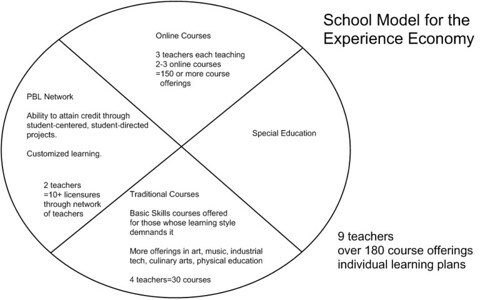
So, how will this happen? The biggest force I currently see driving this change in public education is online learning. It is far cheaper to deliver an online course than a face-to-face course. The cost factor alone is a huge drive behind it. Advances in technology are every day improving the quality of an online education. Rather than speak in nebulous terms I will now turn to more concrete examples. In southeast Minnesota there is a group called the Southeast Service Coop that is offering to schools online courses. For a nominal fee your school can become part of this coop who in turn will train up to three teachers how to deliver online courses and how to develop online courses. Those teachers then have the choice of owning their courses, meaning that they are paid directly from the coop based on enrollment numbers or they can choose to keep their employment status with their school and the school assumes the risk. Should that teacher's class be in high demand the school or the teacher are compensated at a profit. Should that teacher's course not attract enough students it is marked as a loss. With this system, three teachers working in one school could bring with them them hundreds of course offerings in every content area. This will be especially beneficial for small schools that are limited in how many courses they can offer.
If the coop were to integrate student or parent rating systems to rate the quality of specific courses or leave comments about the class (the same way Amazon allows customers to rate products) the motivation for a teacher to offer higher quality courses and instruction is driven by demand. Knowing that should students not find your course useful or engaging that they will be less likely to take your course or knowing that if you provide a good course that students will likely suggest it to others will build accountability into the system that the traditional model simply doesn't have. School choice makes the consumer (the student and their families) the employer (or administrator).
However, not every student does well in an online class and not every class is well suited for online instruction. There will still be a need for face-to-face classes. The benefit though, is with the online courses being far cheaper to offer than face-to-face classes more money can be diverted to courses that are done better face-to-face. This could see a rise in domains such as art, music, industrial technology, home economics, physical education. This rise will also be driven by the experience economy, what Daniel Pink refers to as the "Creative Class".
Not every student does well in traditional face-to-face courses either. That is one reason we have special education. I don't see significant changes in how schools offer special education services. The one change I foresee is with more and more core courses being offered online special education teachers may find themselves teaching more core subjects to their students using the student's enrollment in an online course as the curriculum.
The industrial school model also is flawed in it's ability to address multiple learning modalities. Inherent in the system is a bias for concrete-sequential thinking, a trait highly valued in the industrial age. Not all learners are concrete-sequential thinkers though and alternative teaching/learning methods like project-based learning have proven to be more effective for many. A fourth department is needed in the new school that allows students to direct their own learning and tap individual interests and talents to motivate growth. In this quadrant of the new school model teachers serve as student advisers and students attain school credits through authentic learning tasks. These PBL advisers in smaller schools can be connected to others in a network establishing networked teams of teachers covering all license areas.
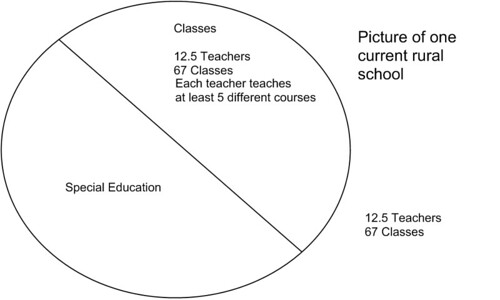
Contrast this model with the current model. Under the current model, the average teacher in a small rural school teaches an average of five different courses. That is five curriculums to develop and manage, five different daily lesson plans, and often these teachers also teach some middle school or elementary school courses. With this new model teachers average only 3 courses that they have to administer while more than tripling the options available to students. When you put families in charge of quality control that further eliminates the need for some management positions. The need for a school administration is also eliminated if the teaching staff (perhaps the student advisers) served as teachers in private practice and shared administrative duties. Essentially, schools in the future will look more like community education centers.
For most of the year I have been blogging about an idea for how small traditional independent school districts might weather the storm faced by disruptive innovation in education. If you have been following my blog you will have seen this idea grow into the presentation I posted a couple weeks ago outlining how schools could embrace disruption by allowing it to happen within their walls but on a very small scale. The idea basically is to take the ITV arrangement many small and rural schools have and use that structure to facilitate the creation of a partially virtual, high-tech, project-based, teacher run charter school that rents classroom space from local traditional schools. In this model the charter school and the traditional schools would form a symbiotic relationship where both working together would be able to offer high quality and diverse learning environments that neither would be able to offer on their own. The hope is that these two models working together would make public education attractive to more students and their families.
Well, the idea looks like it might be getting its wings. I have the green light to explore the idea seriously from the three local school districts. Now, this green light by no guarantees that this school will open by my target of 2010 but it does offer the opportunity to put some serious exploratory effort into it. I want to make clear to everyone that by no means will we submit our charter application this July unless we are relatively certain that this idea will improve our schools for all stakeholders.
We want to involve as many people as possible in this process. To do so I have set up a Ning. I invite anyone with an interest in progressive education, charter schools, project-based learning, education technology, alternative pedagogy, networked learning, or Minnesota schools to join this Ning and help us shape this charter. All feedback and contribution is needed and welcome.
"Education is also the civil rights issue of our generation." -Sec. Education Arne Duncan
I have been thinking lately about this statement and how it might be applied. Traditional schools greatly favor a concrete-sequential learning modality. Most teachers are concrete-sequentialists. Most of our kids who do not do well in school are not concrete-sequential learners. Knowing about the kind of school Ariel is (the school in Chicago that Duncan founded), could this statement signal a new view of students with non concrete-sequential learning modalities as being repressed or underprivileged under traditional school systems?
There has been a lot of ire lately in the edublogosphere about the appointment of Duncan. Gary Stager and others, who I respect greatly, view Duncan's appointment as another four years of the Bush education policy. The argument centers around the support for charter schools like KIPP, the support for performance based pay, union busting, and standards based testing. I have to respectfully disagree.
Yes, the Obama administration supports charter schools. No, not all charter schools are KIPP. KIPP schools have come under the microscope lately and have been recognized as a scale ready solution for kids in poor neighborhoods. However, the attempt by KIPP teachers, who have reportedly been overworked, to unionize has met much Resistance and has gotten messy. The problem is the administration's support for these schools has to some been seen as the only type of charter school they support. There are three things that keep me cautiously optimistic and unconvinced that the writing on the wall spells "KIPP":
Earlier this month the Obama's visited Capital City Public Charter School, a progressive charter school in the DC area. There the president said, "This kind of innovative school...is an example of how all our schools should be."
The Obamas send their girls to a private school that operates under a progressive philosophy.
Ariel Community Academy, the school Arne Duncan founded in Chicago, follows the same progressive philosophy. The following are excerpts from the Principal's message on the school's website:
"The role of the teacher is to assist and advise the student, actively participating and contributing to their learning in order to expand and discover the society they live in and share experiences together."
"[S]tudents should be aware of their own multiple intelligences and utilize a wide variety of abilities to demonstrate what they have learned."
"The design of the curriculum is purposefully broad in order to provide the teacher with many options for planning and implementing individualized, small group, and whole group instruction."
So, could this kind of stated support for progressive education coupled with Duncan's statement about civil rights mean that students who learn differently will now be seen as being unnecessarily repressed? I surely hope so. This is a silent epidemic in our country and one that is being exposed by the largely unpopular No Child Left Behind and the increased spotlight on our nation's dropout rate (National Average is 33%).
This is a difficult problem to draw light to because most educators (most educators are concrete-sequential learners) don't see the problem as a civil rights issue. They can't from their current perspective. "The Color of Fear" is a documentary that brilliantly and effectively explains the problems of privilege and prejudice as they relate to race. Watch this excerpt of the film and every time you hear the word "White" replace it with the word "Concrete-Sequential."
What do you think? Is learning modality a civil rights issue?
Could it be that the writing on the wall is not "KIPP" but rather "Choice"?
Do you think I am way off base and Duncan's is viewing civil rights as it has historically been defined (that of Race, Gender, Ethnicity, Religion, etc)?
For those of you who have been following my blog you will know that I have been exploring the possibility of starting a new charter school in Minnesota that is partially virtual but will exist as digitally connected classrooms within the walls of our existing public schools. If you are interested in this idea and want to be involved please fill out the interest form below:
Quite often it is the rule rather than the exception in politics that the headlines you read in the paper don't really tell the whole story. That story is only revealed later. A couple of years ago I had the pleasure of taking an education policy class from Dan Loritz in Hamline University's Graduate School of Education. Dan would often talk about the headlines and policy decisions repeating this mantra, "Only time will tell if this is good fortune or bad fortune." Such is the recent hullabaloo about the state of MN trying to pass policy that would tighten restrictions on Charter schools.
If you work for or are a stakeholder at any level in a charter school in MN this legislation looks on the surface as something that should cause alarm. It potentially could reduce funding for lease aid, clamp down on accountability that might or might not fit with the charter school's mission statement and educational philosophy, and could throw the proverbial monkey wrench in much of the operations charter schools currently face. Is this necessarily a bad thing? We need to be careful who we attack and who we lobby against. We just might be biting off the hand that feeds us.
This all became a bit more clear for me today. Curious about what might be in store specifically for education in the monster stimulus package slated to pass the senate later this week I found some interesting language that puts the current legislation regarding charter schools in MN in focus under a different light; a light that might paint tighter restrictions as good fortune rather than bad.
First, Tom Huffman wrote last week about President Obama's visit with children at Capital City Public Charter School in Washington D.C. more or less scolding the edublogosphere for not responding immediately to this trip in his piece, Is "No Comment" the Best We Can Do? Truth be told, I don't think most edubloggers had their eye on the ball on this one. Those of us who did have been slow in responding. However, this probably is not a bad thing. Carefully drafted posts require time for digestion and reflection. The reason this visit was important was because Capital City is a progressive charter school and the president's comments there reflect what I and many of my colleagues hope to be a statement that will set the tone for his education policy. As he visited the school he said, "This kind of innovative school…is an example of how all our schools should be."
This got me wondering what other evidence there is online that might shed light on the President's stance on progressive education and/or charter schools. That led me to this January 29th article in Teacher Magazine that gives a brief overview/preview of what elements of the economic stimulus package might be slated for education and how those funds are to be used. From that article:
The Obama administration is seeking to boost spending by nearly $500 million on reform-minded programs that fund teacher bonuses tied to student performance, and pay for charter school facilities and state data systems. The spending is in the stimulus plan approved Wednesday in the House, but it is not in the Senate version.
Also, on the White House website under the president's Education Agenda:
Support High-Quality Schools and Close Low-Performing Charter Schools: Barack Obama and Joe Biden will double funding for the Federal Charter School Program to support the creation of more successful charter schools. The Obama-Biden administration will provide this expanded charter school funding only to states that improve accountability for charter schools, allow for interventions in struggling charter schools and have a clear process for closing down chronically underperforming charter schools. Obama and Biden will also prioritize supporting states that help the most successful charter schools to expand to serve more students.
This brings us back to the state of MN clamping down on charter schools. Could it be that the drive behind this legislation is not to crush the charter movement but rather to open the door for more federal dollars to support successful MN Charter School programs? What I have seen of the legislation being passed around right now seems to take these last few lines in Obama's policy agenda almost verbatim.
And what charter schools are the best performing? Typically they are the ones that are the most progressive. However, this could all be for not if a two year moratorium on the formation of new charter schools passes in the state senate.
I have been thinking lately about how a project-based charter school within a school could work. Here are my thoughts on how the learning process would be structured:
Lets face it, the disruptive forces described by Clayton Christensen in "Disrupting Class," this post on Fluid Learning, and the subsequent conversations that have emerged today on Dean Shareski's blog and Will Richardson's blog are going to have an effect on our schools. These forces include the internet, personalized learning, and school choice. So far what we have seen play out is as technology and the internet improve the choice to either home school a child or enroll them in an online school has gotten easier; as more charter and magnet schools open they pull students from the enrollment of our traditional schools; and the inflexibility of our schools has led to an increased dropout rate and a growing number of students who see more value in teaching themselves what they think they need to know than seeking a diploma or degree. The result has been lots of either/or scenarios. You are either enrolled in an online class or you are enrolled in a traditional classroom...you either are home schooled or you attend a public or private school...you either are mainstreamed or you are in some kind of alternative program. This approach has spread us thin. All of these approaches either ignore altogether or place bets on the disruptive forces and such a polar choice leaves few good choices in the long run.
What is it, or what was it, about the schools we grew up with that our communities loved? What programs did those schools offer that added identity and built community? I would suspect that for most of us those things were the arts programs, athletic programs, extra curricular activities, clubs, and organizations. These were the things we celebrated and these are the first to go when disruptive innovation is dealt with in a polar fashion. How can we retain what we hold dear about our community schools in the face of disruptive innovation?
Before we can answer that question we need to look at what the disruption really is. The disruption is the internet. The internet is what is behind the flat world that Thomas Friedman talks about and it is the tool that makes the kind of grass-roots social action and semantic restructuring that Clay Shirky describes. The internet is the largest collection of data and information our world has ever seen and it makes information cheap. It also allows for the outsourcing of or automation of tasks that are routine. However, the internet is more than the sum of it's parts because behind each window that looks into this great big machine sits an individual with thoughts, knowledge, and wisdom. It allows for us to connect in ways we never could before not only with data but with each other.
Daniel Pink also addresses this issue by observing that what this disruption is going to call for in the economic world are people who can exercise the right sides of their brains, see the whole picture, and be creative. The polar approach we have been taking in response to this disruption has forced schools to cut back on programs that typically best nurture this ability in students.
Now, there are other disruptions that are effecting our schools besides just the internet and the rise of school choice. First, there is the health care crisis. When you look at projections for the cost of Medicare and Medicaid in the future, especially as more and more baby boomers retire, there will be less and less funds available for public education. This means either schools will loose funding or an already poor health care system will get even worse. Also, the recent downturn in the economy will have an immediate short-term effect that we won't be able to ignore. Two reasons schools will loose funding added to the loss of funds due to declining enrollment caused by school choice.
Why does this have to be so? As Christensen eloquently explains, large systems are ill equipped to implement sweeping changes. He gives examples in business of how disruptive innovations literally kill certain industries and examples of companies like IBM and Dayton-Hudson who weathered the storm by embracing the disruption and allowing it to flourish. Why can't we do this in our public schools?
I suspect one problem has to do with our miscategorization of different modalities of teaching as modalities of learning. Cognitively, is online learning any different than any other type of formal learning? Certainly online teaching is different than teaching face-to-face but is learning any different? One benefit to online schooling is the students have to be active learners, in an online learning environment passive learning is equivalent to absenteeism. In that way there might be a difference but active learning is active learning and the same level of engagement can be achieved in a traditional classroom as well. Online teaching strategies can be applied in a traditional classroom to support and extend learning just as films can be shown in classes to support the curriculum. Why do we have to think of online learning as one form of learning separate from others?
While there may not be a significant difference in how we learn online as opposed to face-to-face there is a difference in how we learn with different types of assessments and teaching strategies. From a funding standpoint we really have two different models: seat time vs. project-based. One involves a talking head and the other authentic assessments and both can be employed in either an online setting or face-to-face.
So, here is the solution I propose to deal with all of this:
Schools need to start by embracing disruption and support it.
They can do this by starting charter schools within their own walls, a school within a school concept.
One charter school could be created that leased space in each of the host schools.
This charter school would serve students who are dual enrolled in their school and the independent school district the charter is leasing a room from.
These classrooms could be connected through digital tools and/or ITV
This charter school would be based on a project-based model instead of seat time but employ online teaching strategies to enhance and facilitate instruction and inquiry.
Students would meet one day a week with their teacher in the charter but have access to daily classes in the traditional school. The other days the students could work from home.
The days students are present the teacher could meet with 10-15 students thereby keeping the perceived class size down to ideal numbers but meet everyday with a different group thereby increasing their enrollment for one instructional class hour to 50-75 students. This will reduce the cost of education.
The independent school districts could then pass these savings on to retaining and growing programs that are done better face-to-face on a daily basis.
This charter need not be a diploma granting institution and could exist only to support and enhance education in the ISD.
This model could be franchised and opened in other schools. The more schools that allow a classroom for this charter in their district the better both schools become because more teachers in the network mean more course offerings and more funds directed toward arts, athletics, and extra curricular programs.
Many of our smaller schools already have a program that sets a precedent for this since most smaller rural schools have some kind of ITV setup and collaboration with neighboring districts.
I am serious about making this work and have been thinking about it for close to 3 years now. I have a potential sponsor for the charter and three districts with administrators interested in trying this out as well as 7-10 teachers who are interested in piloting this program so it is very possible this idea might fly. What are your thoughts? I would love any and all feedback.