Should we approach technology in schools the way we address language?
We use terms like digital literacy and digital fluency to describe one's level of comfort and ease with which they navigate digital space. We use the same terms to describe English language learners in our educational spaces. Do the same issues apply to digital language learners as do English language learners? I think so and I think it also shines a light on an issue with tech integration and possibly why it has not statistically proven to produce grand results.
The problem is, if I am working with a group of students who have limited English skills there is only so much I can teach them. Limited vocabulary gets in the way of me elevating students to the level they would be with my content were I able to teach them in their native language. Therefore, all classes I teach with ELL students become English classes despite what the content is supposed to be. If I am teaching a lesson on how search engines work, much of that lesson ends up becoming a vocabulary lesson and many of the more abstract concepts barely get realized. These students are learning a new medium, English and that learning comes before the content.
Now, suppose I take a class of non-ELL students and introduce a new tech tool to them. I integrate this new tool, this new medium, into my lesson. The students are expected to use this new medium to learn about and process some other content. They face the same dilemma my ELL students faced with learning English. If the tech tool is new, the new learning becomes the tech, not the subject content. I cannot successfully ask students to master both a new medium and a new curricular concept at the same time. One takes precedence over the other. If I am constantly introducing my students to new and different tools it will slow their acquisition of content knowledge just as a language learner is splitting focus between content and language.
I have been watching school districts push new digital tools pretty hard for about a decade now. Often I played a pretty active role as an instrument of this trend. I have seen the push for interactive whiteboards, student response systems, learning management systems, iPads with educational apps, etc. The one thing these tools all have in common is they were designed for the classroom and are not tools our students use at home. Therefore, regardless of how tech-savvy our students are, when we force them to integrate these tools into their learning they all become technology language learners. The same issue applies. Am I teaching tools or am I teaching content today?
Why do we invent new mediums that only schools use? Why not integrate technology students already use? Why not allow students to choose their own tools? I often ask my ELL students to do heavy content work in their native language first and later translate it into English for me. We can integrate technology while keeping the focus on our content. It just needs to be technology students are already fluent with.
Every time I address this topic, and it has come up many times over the past decade, I get the same kind of push-back. I will never understand why tools designed for schools are more acceptable than tools designed for people.
Something has been bothering me. I am bothered enough to awake from my self-imposed social media slumber. I have been away from blogging and Twitter for quite some time. Some of my inactivity on social media has been because it became professionally unsafe for me to write about my work for a few years. But mostly it is because once you fall out of the habit of blogging it is hard to pick it back up. Anyway, something has been bothering me enough lately to start writing again.
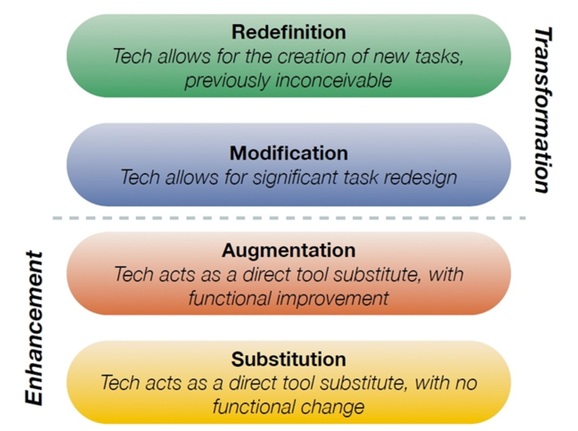
What is bothering me is how I see so many school systems using SAMR. For those who are unfamiliar with SAMR, it is a framework that describes the adoption cycle of technology. It stands for Substitution, Augmentation, Modification, and Redefinition. Basically, the theory goes that when a person or group is introduced to a new technology they first use the technology to substitute for something they did before. Then, after time they move to using technology to augment what they do. Then, the technology works to modify what was previously done. And finally, the technology allows for new things that could not be done before without it. This final stage is referred to as Redefinition. This observation is very similar to what David Warlick used to often say in lectures, "First you do old things the old way, then you do old things in new ways, and then you do new things in new ways."
What irritates me is so many schools have been using SAMR as a way to talk about technology integration in the same way we talk about Blooms Taxonomy. SAMR gets talked about as if the R is something to work toward. As if Redefinition is a state of adoption that is better than the other stages. I don't think SAMR should be viewed this way. SAMR is not something we actively seek out, it is a way of describing what happens naturally.
This misuse of a perfectly good technology adoption theory is evident in the examples often given for school activities that fall along these four areas. Here is a prime example:
Level
Definition
Examples
Functional Change
Redefinition
Computer technology allows for new tasks that were previously inconceivable.
A classroom is asked to create a documentary video answering an essential question related to important concepts. Teams of students take on different subtopics and collaborate to create one final product. Teams are expected to contact outside sources for information.
At this level, common classroom tasks and computer technology exist not as ends but as supports for student centered learning. Students learn content and skills in support of important concepts as they pursue the challenge of creating a professional quality video. Collaboration becomes necessary and technology allows such communications to occur. Questions and discussion are increasingly student generated.
The example given here for Redefinition is something I was asked to do in the 1990s as a high school student using a VHS camcorder. This clearly is an example of Substitution. Rarely have I seen anything in these examples that wouldn't actually fit into the Substitution, Augmentation, or Modification areas. Redefinition is just so hard for us to imagine that we don't usually notice it until it has already happened.
I think that the closer a teacher actually comes to Redefinition in their practice the more at risk they are of loosing their job. This statement has always met with strange looks or with vehement argument whenever I have made it before. However, I do believe strongly that this is true. To explain my reasoning let me offer an alternative example of the four stages in the SAMR model. For this I am going to look at just one technology and how it has changed my learning.
In 2005 YouTube was introduced to the word. I was teaching art at an alternative high school at the time. My students and I quickly began using this tool in our classroom. At first I started looking for videos on YouTube (and other Tube Sites) to replace the instructional videos I used to show in class. This is clearly an example of Substitution.
I then started having students use the search feature in YouTube to locate videos related to their own research topics. This might be considered an augmentation since the immediacy of the search engine made this much more effective than taking a class to the library, searching through a card catalog, locating the video on the shelf, and then bringing it back to school.
Then later, when we became more comfortable with this new tool, I had students make and publish videos giving critiques of their favorite artists. One artist whose work was critiqued was still living in Australia. This artist saw my student's video and responded with a video of their own directed toward my students. This exchange led to a video pen-pal situation virtually bringing this professional artist into my classroom as a co-teacher for four months. This would be a Modification.
Now, since 2005 I have not spent a dime on a mechanic to work on my car. I was never very much into automotive repair and was personally intimidated at the prospect of working on an engine. However, I have found that I can fix my own car almost every time it breaks down by finding a video on YouTube showing me step-by-step how to do it. This is Redefinition. YouTube and Google have made many things unnecessary that were essential before.
Prime example of Redefinition in student learning.
This is just one example. I can easily apply this example to other technologies with similar results. The fact is, none of these stages was any more powerful or effective for teaching than the others. They were just different. SAMR describes what happens when you introduce a new technology, it is not a goal to achieve.
This idea is not new and those who have let technology Redefine teaching and learning in their classrooms have often found that the school system has a way of not putting up with it. Our school districts may say they want teachers to work toward Redefinition in their classrooms but teacher evaluation models don't show it. One way the Internet-connected 1:1 devices allow is a type of learning that is student-driven and individualized in ways it was never possible to do before. If we were to allow our classrooms to be Redefined by these tools we might offer students a learning environment where we allow students to set their own goals and learning objectives and use these tools to help facilitate their own learning. Such an environment may be rich in resources but gone would be conventional ideas of what constitutes "instruction." If a teacher allows students to set their own learning targets or pursue their own interests it falls short on most teacher evaluation models. Our evaluation models are meant to measure how good a teacher is at leading and guiding students through a teacher-driven curriculum. School policies often don't show room for Redefinition either.
Seymour Papert wonderfully describes how teachers changed the way students learned math by using computer programming to make a kind of "Math Land." In this "Math Land" students learned advanced mathematical concepts in the same way one learns a new language through immersion. These early pioneering teachers integrated computers into their classrooms. Soon though, the school systems collected these devices and corralled them into a room ominously called the "computer lab" and gave computer science it's own "subject" to be taught. This also allowed these machines to be utilized as testing centers to facilitate and streamline standardized testing. It isolated this disruptive innovation preventing further Redefinition.
So, if you are truly letting technology Redefine your teaching and learning then you may soon find yourself out of a job. The traditional school model will find a way to corral you or the Redefinition may actually be redefining what "teaching" needs are still relevant and necessary. I find myself more and more looking at my job as ensuring that I offer my students a learning environment where they have access to whatever resources they need to learn on their own and conditions with which to achieve their own goals and less "teaching." Unfortunately, most school districts do not measure teacher performance with a tool that will measure this kind of work. And, our continued need for students to perform on a standardized test will mean that our profession will continue to be limited to the SAM portion of this model.
EdcampMN is professional development FOR teachers, BY teachers. Experience professional learning that’s active, flexible, democratic, participant-driven…and FUN!
I am excited to be co-hosting with Scott Schwister and Kelli McCully our now third annual Edcamp Minnesota! This year's planning has been slow and for a long time I didn't think we were going to be able to have an event. But, what is it they say about those who wait? I know it is short notice but we would really love for all educators, and anyone interested in education really, to join us at Hamline University on July 25th. The event is free.
Though it is not really in the tradition of Edcamp to select a theme, themes do tend to arise. It looks like this year's unofficial theme is "Learning Environments." This Edcamp will showcase a fabulous new building at Hamline University, the Anderson Center. Also, our keynote speaker is world renowned school designer Randy Feilding!
*
*
EdcampMN 2013 Coming Soon!
AnnouncingEdcampMN 2013: Join us in July for an exciting day of transformative learning!
EdcampMN
is professional development FOR teachers, BY teachers. Experience
professional learning that’s active, flexible, democratic,
participant-driven…and FUN!
It happens once and we have room to blame it on the instability of a single individual. It happens twice and we have grounds to attribute the problem to access to guns. It happens three times and we look for similarities. We then might deduce that psychotropic drugs are to blame. It happens five times in one year and consistently for as long as it has and at some point we have to face the fact that there is something very wrong with our culture.
I can't sleep tonight. I have two daughters, one in second grade and one who will enter kindergarten next year and I can't help but think that tonight there are twenty parents staring at presents under the Christmas tree that will go unopened, stockings that will go unstuffed next week, and beds that lie empty. I can't fathom the dwarfing sense of loss these parents must feel, it hurts too much to fully empathize. And the lingering question on everyone's mind is, "Why?"
I think of the unconditional love I have for my own children and then I think about how much we hear people talk about the value of unconditional love but how seldom we hear anyone speak of unconditional acceptance. Now it is too early to know specifics about what happened this morning in Connecticut but we certainly know a lot about the other mass shootings we have suffered over what now is nearly a whole generation. I surmise that the common issue among all these tragedies stems from a culture that doesn't value or practice unconditional acceptance. Our culture in practice does the opposite. It sorts and exploits.
A. S. Neill believed that children only have two basic needs, they need play to learn and unconditional love and acceptance to nurture. He also believed that discipline is an expression of self hate of which the victims become the haters. With the numbers of people in our prisons it is hard not to conclude we are a culture of discipline. Now, take someone who has been pushed to the edges of society, labeled, clinically diagnosed, medicated and deny them the unconditional acceptance they need to be emotionally stable and they will exhibit antisocial and even destructive behaviors. I saw this consistently on a smaller basis in alternative schools. However, take a person in that fragile state and show them that you support them and accept them unconditionally and they begin to build the psychic foundation they need to get better. This is true for both children and adults. But, that is not the culture we live in.
Our culture ranks and sorts people through standardized tests, special needs assessments, tax brackets, and social standing. Our culture relies on clinical analysis of test results to treat everything from heart disease to anxiety disorders and depression. Instead of treating the human being we treat the patient. Our standards of measurement have turned people into objects. We watch the exploitation of those most consider different on The Learning Channel (TLC): Here Comes Honey Boo Boo, My 600 lb Life, The Little People, Hoarders, Extreme Couponing, all teaching us to view those who are not "normal" as something other than the kind of human being the rest of us are. We numb our sense of horror by watching violent television shows and playing violent first-person shooter games which also reinforce this notion that some people are objects. Once we accept a clinical diagnosis that proclaims someone different from us it is not that hard to accept a wrong-headed view that they are somehow less human. In all previous mass shootings the gunmen exhibited a pathology that indicates they may have felt this kind of objectification, this kind of ostracizement.
We like to talk about unconditional love for our children. We like to talk about acceptance and tolerance with regard to race, religion, or sexual preference, but we never talk about unconditional acceptance or what a culture built upon love and unconditional acceptance might look like. To build such a culture we would need to eliminate clinical diagnosis that breaks us down and categorizes us. We would need to eliminate sources of rank and file within our institutions. We would need to move from a society that disciplines to one that nurtures. We would need to deschool society. To do so would heal so many mental illnesses and help prevent the sort of tragedy that happened today. While I look down on my daughters as they sleep in their beds tonight, overwhelmed with unconditional love for them, I hope that somehow I can instill in them an unconditional acceptance of all people. And I hope that that unconditional acceptance can spread, permeate the culture. If you change the environment you change behavior, if you change the culture you change the environment.