Showing posts with label Dean Shareski. Show all posts

Thursday, October 28, 2010

Weekly Tech Tip - K12 Online Conference

Rather than post one of my regular Weekly Tech Tips this week I would like to turn your attention, if it is not already there, to the K12 Online Conference. The K12 Online Conference is a free annual online education and technology conference. Unlike other conferences this one is asynchronous and all presentations are archived for future viewing. The session presentations are created and shared using web 2.0 tools (most of them free). Sessions are curated by a group of conference conveners and in the weeks of the conference they release the links daily to give the sense of an event. These sessions are created by teachers with real classroom application in mind.

Weekly Tech Tip:

Opening Keynote: Sharing: A Moral Imperative by Dean Shareski


http://k12onlineconference.org/

K12 Online Conference 2010 via kwout

--------------------------------------------------------------------------------------------------

Video Festival:

The Seven Spaces of Technology in School Environments from Ewan McIntosh on Vimeo.


Link Stew:

Blog Carnival:

Retweetable Tweets:

RT @luhoka: I think people underestimate how much respect is given to those that actually say "I don't know"less than a minute ago via Tweetie for Mac

Monday, December 1, 2008

This Will Not Be On The Test

Dean Shareski over at Ideas and Thoughts of an Ed Tech wrote a thoughtful response to Time Magazine's article about Michelle Rhee today. The following are the comments I added to his post:

I think @wmchamberlain is on the right track by stating that the problem lies in our lack of a concrete purpose for schools. However, our lack of a concrete purpose I think is the result of a larger problem for which the problems in our school systems are a direct result. The problem lies more in what driving forces our human race has allowed to guide everything from our structures of governance to our schools, to how we fulfill our material needs. This problem has its roots far back in our history to the invention of money for trading goods and services. Where at first benign, this tool has allowed the worst of human traits to inform and direct nearly every aspect of how people relate to one another, how we treat our environment, and what we value. For money to work we have to have a fundamentally universal understanding of the definition and concept of ownership. More specifically, things become possessions. Possessions can be traded. A variable can be assigned to hold the value of said possessions. Thereby laying the foundation for our economic system. A system that can be taken advantage of. An abstract system based on the abstract concept of ownership. When that system crashes as it has recently we don’t see material disappear, we have not really lost anything real. What we loose is the illusion we have created by investing in abstract concepts such as ownership and money.

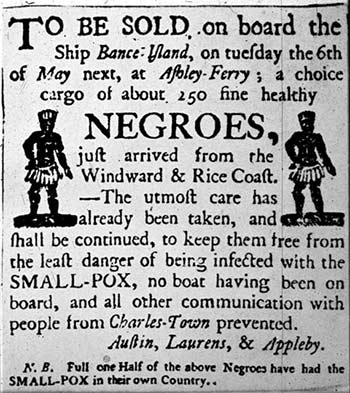
Ownership has had different meanings historically by different cultures. Traditional American Indian cultures had a very different understanding of ownership than feudal systems that emerged in Europe or even Eastern cultures such as emerged in Tibet or Bhutan. Under feudal systems the concept of ownership was less abstract but was the foundation for it’s existence. The monarchy owns everything. The populous is granted by the monarchy permission to use their goods. As cultures indoctrinated under feudal systems evolved and systems of government changed the concept of ownership remained. These cultures later spread their view of ownership across the world through colonization, enslavement, genocide, and more recently commercialization. This understanding of and value for the concept of ownership and the evolved need for our species to hold on to this abstract notion has spread throughout the whole world. Cultures who have a different concept of or no concept of ownership at all are either looked at as primitive or are forced to comply and reform. Not to do so often results in the loss of basic needs, imprisonment, or even torture.

Ownership is control. Our economy dictates who has this control. Our governments are chiefly concerned with the economy. Our governments mandate standardized testing in math so members of our society can participate in this economy and understand their place. Our governments mandate standardized testing in reading so members of our society can communicate well enough to help drive this economic engine by producing goods and trading them with each other. All traditional reasons given for what schools are for all equate to the same thing: Schools exist to reinforce the concept of ownership and produce adults devoted to this notion thereby maintaining structures of control.


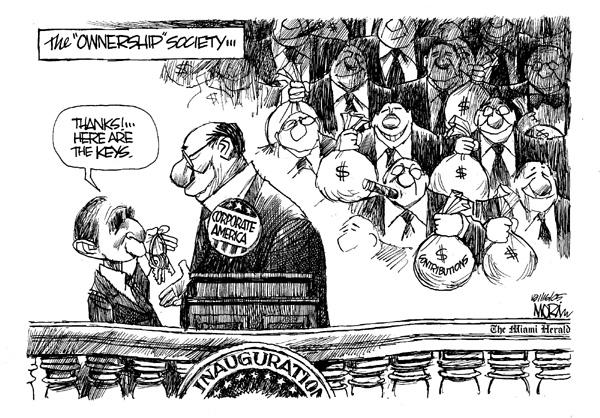
We are starting to see the flaws inherent in basing our society on the concept of ownership unravel. Ownership begets greed and greed begets lust, gluttony, and envy. Greed and gluttony have resulted in the decline in our environment that if left unchecked will ultimately result in our own extinction. This ownership society has also resulted in the diminished quality of life for most people living in third world nations and many of the poor living in our industrialized nations. This includes the “at risk” students in our schools whose basic needs are not met.

Now, we have collectively developed some concepts that run counter to the idea of ownership and have thus thrown a wrench in the ownership control system. Those include the Bill of Rights which includes freedom of speech. Based in our right to free speech the recent open source movement has brought the concept of ownership into question. Creative Commons also throws a wrench in this ownership idea as do socialized medicine and universal health care.

Our failing schools are a result of the collapse of the ownership doctrine. Standardized tests test a student’s ability to thrive and participate in an ownership society. What subjects of study would we value more if we eliminated our current concept of ownership? What would our world look like if ownership did not reign supreme. Those teachers, administrators, and politicians who support standardized testing, teach to the test, and use standardized tests in math and reading to measure the success of a school are agents of the ownership society. They are agents of a social system that has historically included slavery, genocide, torture, and greed.

Friday, March 28, 2008

What Software Programs Do Our Students Need To Learn To Prepare Them For the Future

I hear too often that we should stick with this platform or that or we should use a certain software program because our students need to learn how to use them when they leave school. This bothers me to no end and lately has really gotten under my skin. I think the footnote at the end of Dean Shareski's post, "Unlearning," says it all:

Footnote:
One of our high schools sent 2 students to a provincial skills competition in video editing. They realized a week before the event that the competition would be using Macs, iMovie and Final Cut Pro. These students had never used a Mac. Their teacher wanted to pull them out of the event but the organizers encouraged them to compete. They received a 20 minute tutorial immediately prior to the full day competition. They gained a silver medal out of 15 competitors.

Skills are transferable between platforms. Of course there is always a learning curve with a new platform but in your students case it looked to be a 20 minute curve (not bad).

When I was in high school we used Macs. They were Mac Classics with Claris Works and Hypercard installed on them. How often do you think I use these programs? How often did I use them in college? The fact is we can't prepare students for the exact technology skills with the exact platform they will be using when they leave our institutions because those platforms have not been invented yet. We can, however, expose students to different types of computing and different types of applications that share conventions with other similar programs. We have been using office and studio software long enough to anticipate which skills will still be needed in future programs and future platforms.

If we look at current developments in IT as predictors of the future apps we see cloud computing on the quickly approaching horizon as being extremely significant. The nice thing about this category of software applications is they do not exist on anyone's personal computer, they exist online. If they are online it does not matter what platform you use to access them so long as you have a reliable web browser and a decent connection.

The advent and probable future significance of cloud computing makes it possible to discard costly systems like Windows and Mac and go with an open source operating system on a cheap PC and still have access to the same programs you would on a machine running proprietary OS software. Think of the cost savings and what it could mean for schools' tech budgets. Take Apple or Microsoft out of the budget and you suddenly have a lot more money to spend on hardware.

Sure, we still will probably want to have a handful of powerful machines with proprietary software installed for our power users but what percent of student use computing fits this category. I agree with Clarence when he says that sometimes all he wants is a simple OS with access to the internet and a few basic applications.

Saturday, March 22, 2008

Assessment in Web 2.0 Learning Environments

There is an interesting conversation that has started between the writers at Techlearning blog about how we should assess student work when they are using web 2.0 tools. David Jakes raises some interesting questions in his post (that follows a conversation that occured in Dean Shareski's ustream session last night). I tried to post the following comment on that blog tonight but every time I tried it returned as an error. Frustrated I am posting it here:


Jake's Question:
How do you assess contribution in a networked classroom?

Ok, so what does it look like? What's new, what's different, what's the same? Your ideas?


My Comment:
I must say that this question still requires some distillation. If you are talking about the mechanics of how to do assessment in these networked environments the answer is RSS subscriptions. I try to encourage teachers in my school to utilize web 2.0 tools such as wikis and blogs and the one overwhelming concern is how do I manage this information overload and how do I know when someone posts? The answer is to aggregate responses into a single reader so you are notified when someone posts among various places.

The flip side of this question, and the side that is most important and I assume is what is really being asked here has to do with how we define the rubric. I think it is dangerous for us to assume there is one or could ever be one set rubric for assessing contribution in a networked environment or any other learning environment. This is going to depend highly on what it is you want students to achieve academically. Ultimately, whether we use pen and paper or web 2.0 tools, we have to assess the learning according to the desired outcomes as they relate to the content. Otherwise we are just teaching students how to use the tools. Why do I need to learn this? When will I ever need to know this? These questions will flourish if we approach web 2.0 tools as an end and not simply a means. It is like teaching students how to build a house but giving them new tools to do it. In the end, whether they have hammers, handsaws, and screwdrivers, or power drills, table saws, and air hammers the house still needs to be measured by the same standards and benchmarks.